Let’s Catch Up, Shall We?

Reflections from the past four years (2020-2024)
Come on in and sit down, make yourself comfortable. You look good! It’s been a while, hasn’t it? Now I could give you a list of reasons why it’s been so long since I’ve written to you from the overused “I’ve been busy” to the introspective “I’ve shifted my focus towards unplugging from technology and fostering relationships.” Whether this is true or not is irrelevant. All you need to know is now is the time and here place for me to write my thoughts to the world. Or rather, to my mom because she is the only one that actually reads these.

Four years of life is a long time, so settle in and grab yourself a beverage. We’re going to be here for a while.

2020: The Lost Year The Year I Got a Car
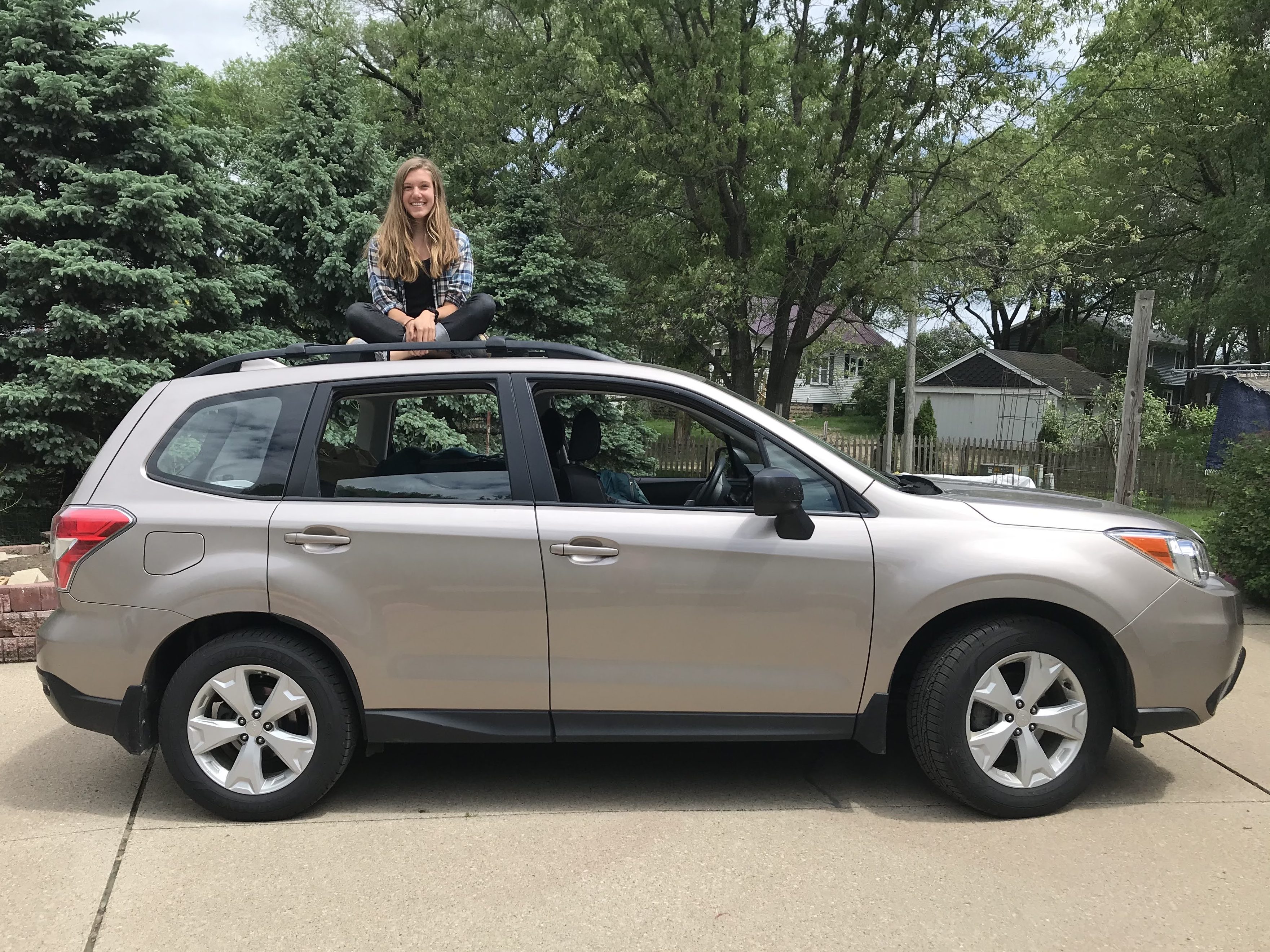
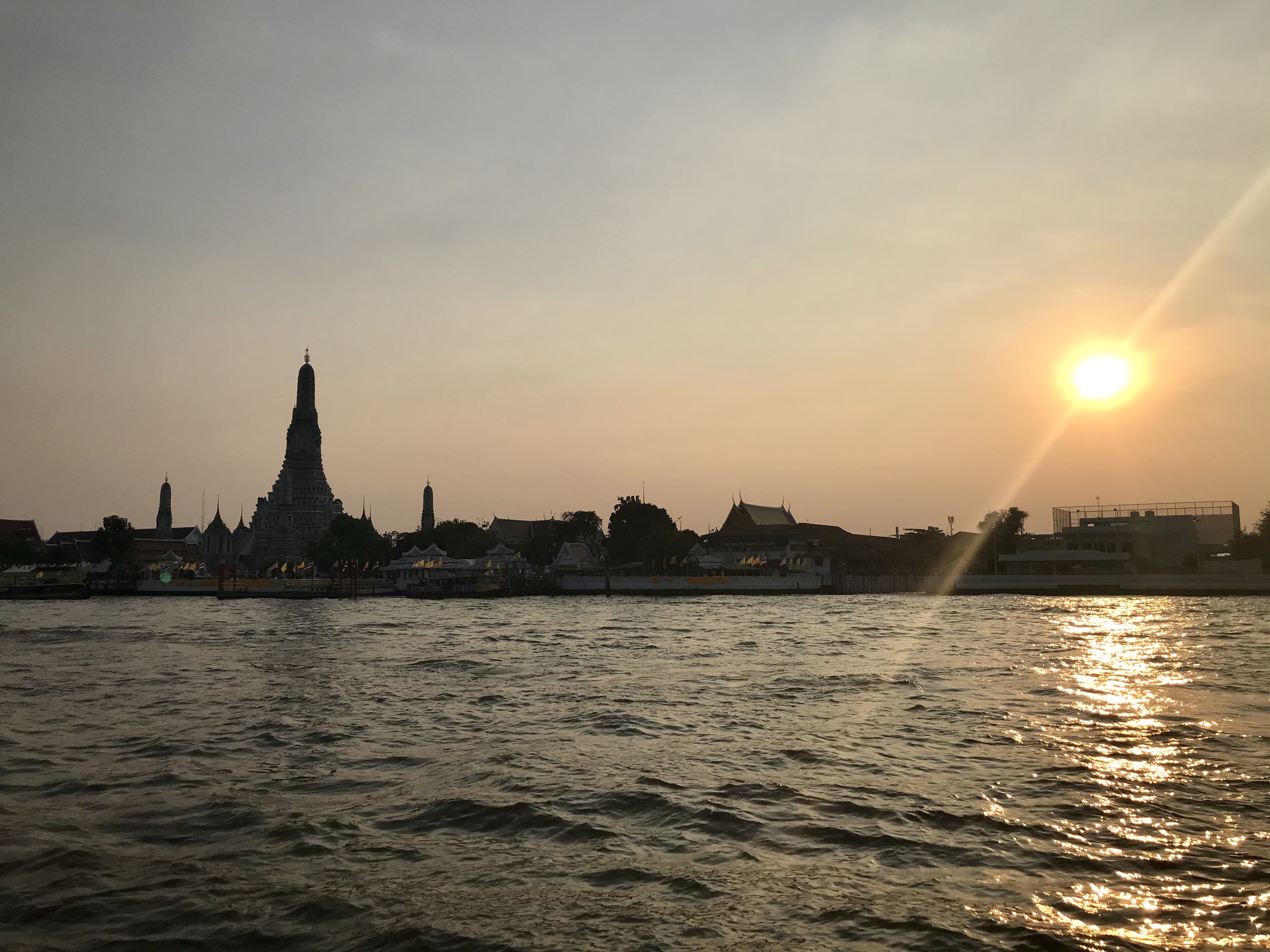
This was to be the year of much great adventure and it certainly started out that way with a trip to Thailand and Laos as I wrote about in the last blog post. On one of my last days in Bangkok there was a big celebration going on for Chinese New Year in the Chinatown district. The hostel I was staying at had planned to take a group to the celebration, but canceled this event due to some highly contagious virus going around by the name of coronavirus. I though nothing of this minor mishap in my trip until March 2020 when the world shutdown. Yet somehow, despite the global pandemic closing the doors and grinding everything to a halt, I managed to have a full year of life. This was mostly thanks to my physical therapy clinicals allowing me to leave Wisconsin in my parents’ Subaru Forester and head to the East Coast to spend the summer in Connecticut.
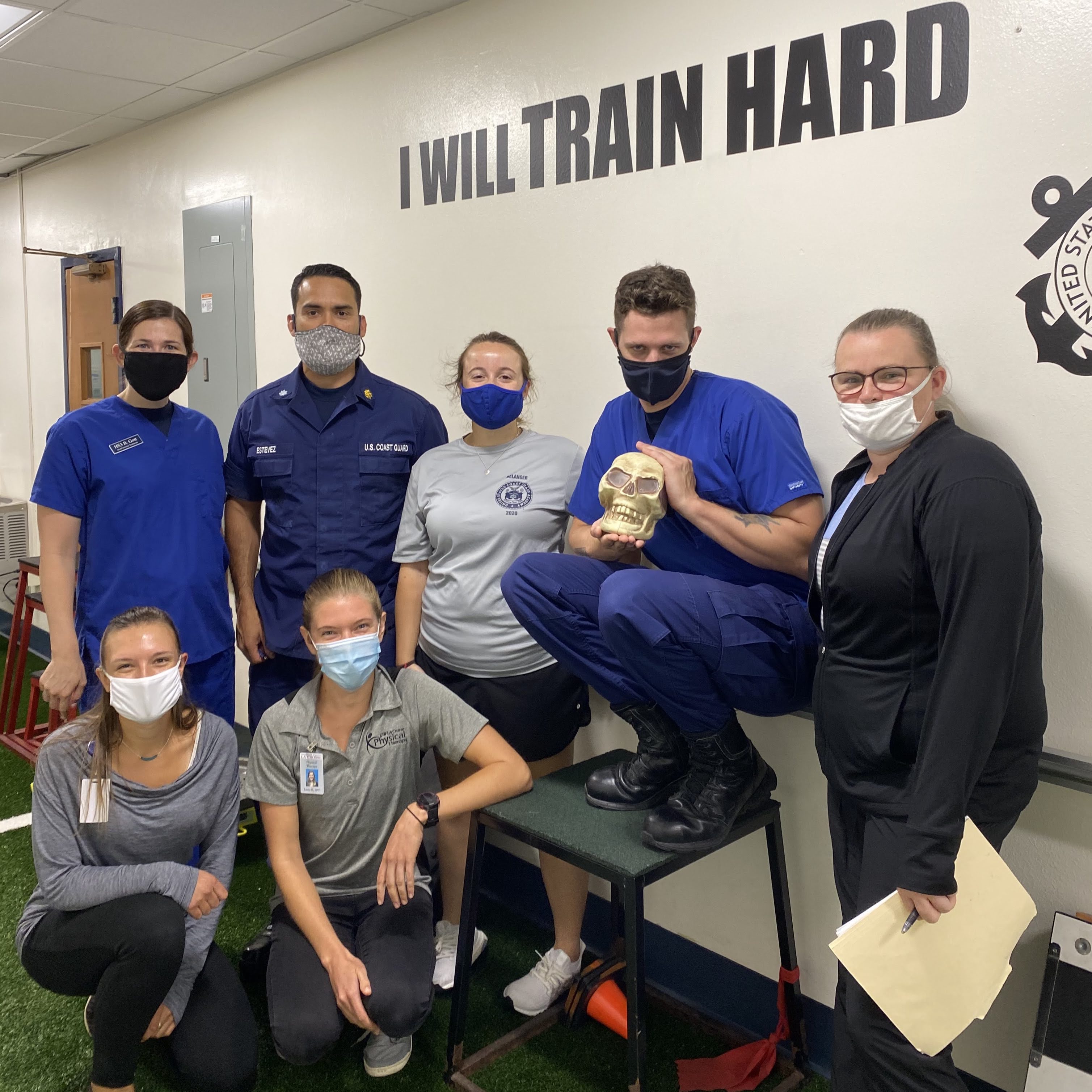
My first stop was New London, Connecticut at the Coast Guard Academy. There was some question as to whether this clinical would run with so many outpatient clinics closed, deemed nonessential business in light of COVID. However the clinic at the Coast Guard Academy was unlike any clinic I’d ever been to, and being a military establishment, followed a different set of rules. We worked through “Swab Summer” where the Freshman prove they’ve got what it takes to be a Coast Guard cadet. I always thought of the Coast Guard as being the “softest” branch of the military. If that’s true, then I can’t imagine what the other branches are like. Those kids get DESTROYED. Supposedly, it was less intense this year due to COVID (just three weeks instead of six), but we were still busy in the PT clinic during those three weeks with a constant flow of ankle sprains and shin splints.

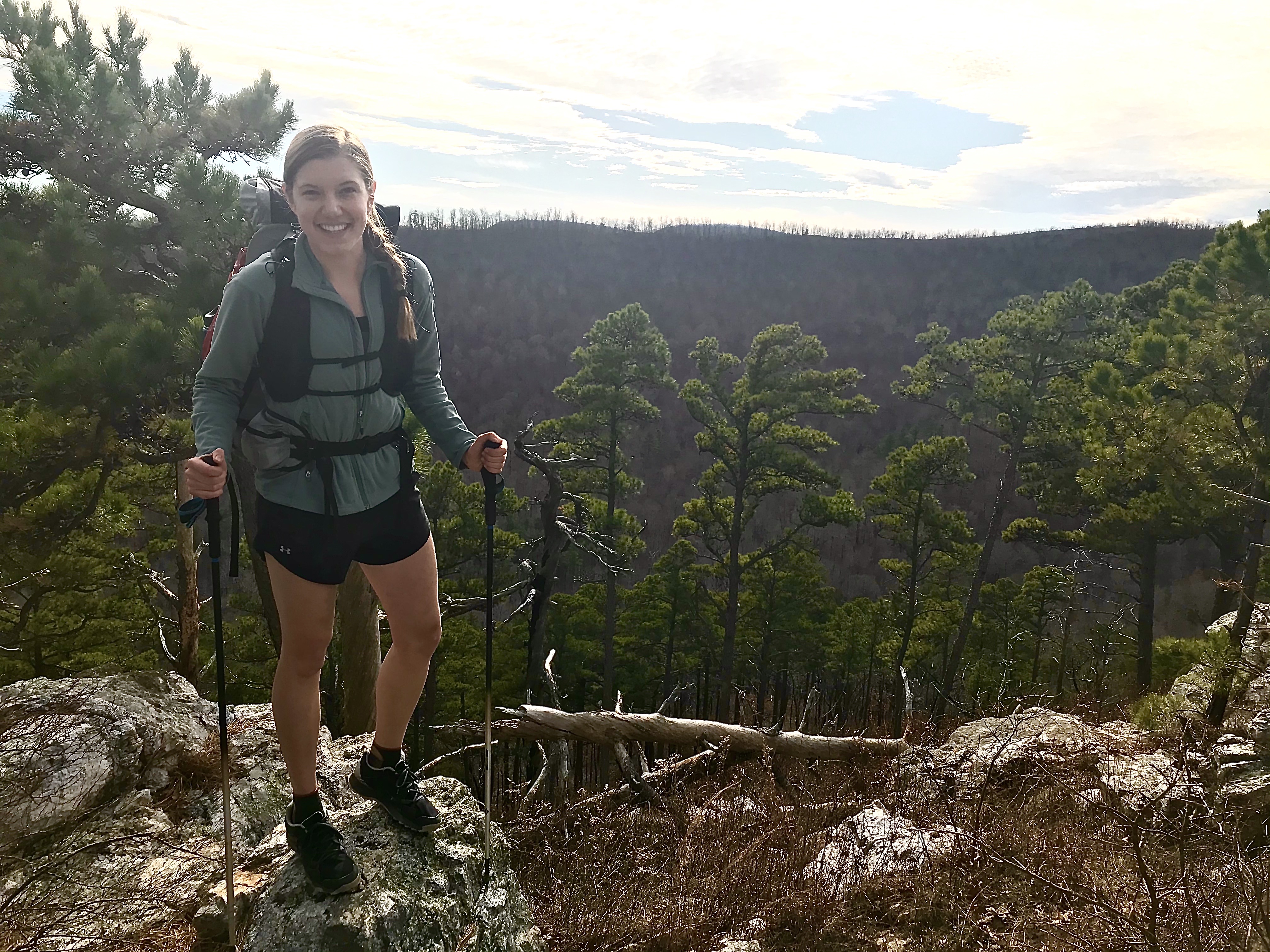
With my board exam in the very distant future, weekends were for exploring. Lobster in Maine, rock climbing in Franconia, biking in Rhode Island, jumping off the docks of Martha’s Vineyard, backpacking parts of the Appalachian Trail, and socially distanced visits with friends in New York. I reconnected with old friends and family on beaches, hiking trails, and in backyards. Yes, COVID changed things, but not as much as I expected.
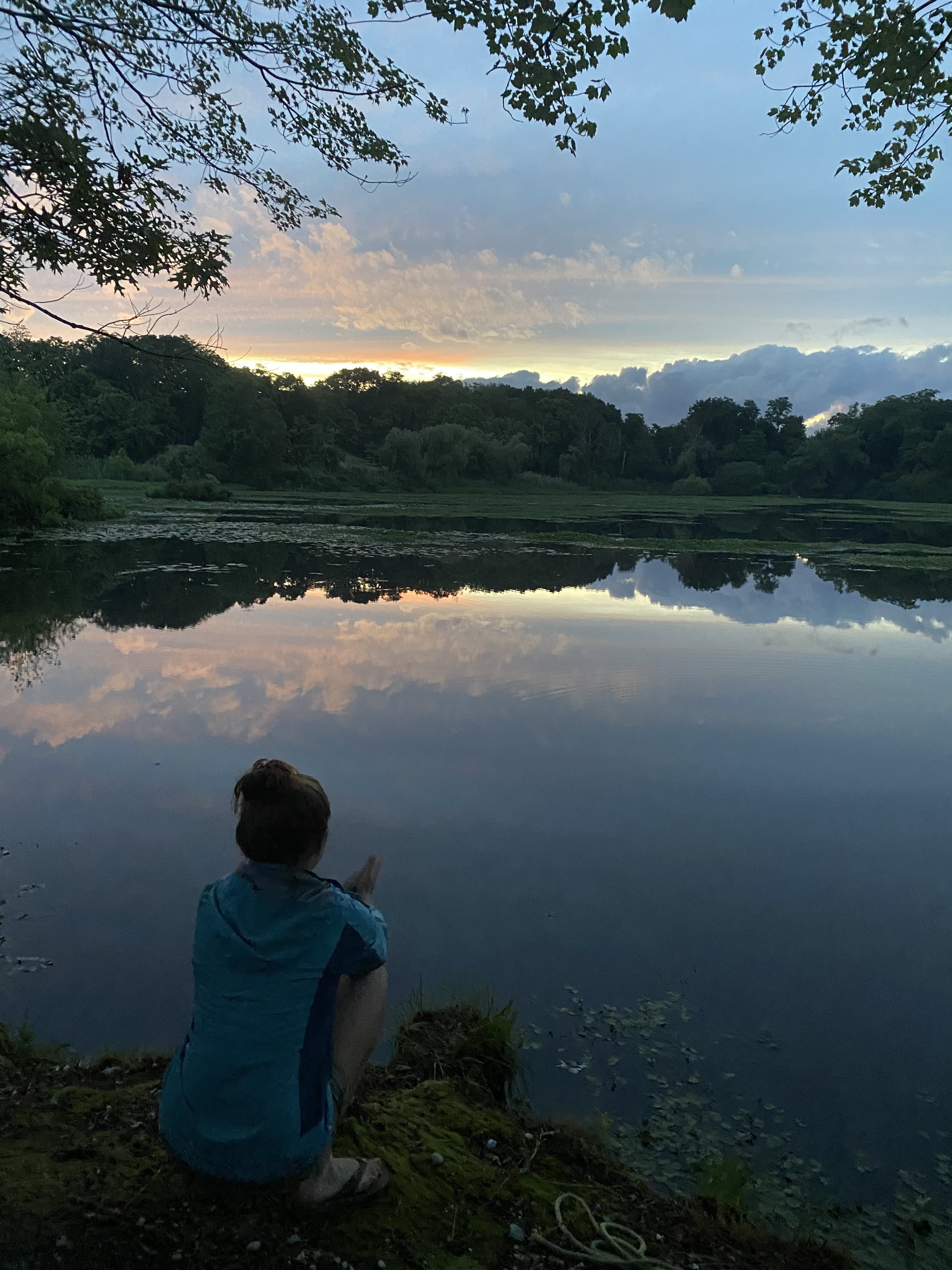
In September I road tripped back to the Midwest and landed in Rockford, Illinois where I completed a three month clinical with the Birth-to-Three Program. Not my ideal location, but definitely my ideal clinical. I got to play with kids for three months while slipping in some therapy disguised as play. It hardly felt like work! I knew this was going to be a fun clinical, but one thing that surprised me was how much I enjoyed educating the parents. We had to go virtual for my final month due to a surge in COVID cases which meant seeing all our kids via video. This confirmed for me that I do NOT want a desk job.

Most weekends in Illinois I escaped back to Wisconsin. A few of my old college roommates lived in Milwaukee and when the weather was nice we would meet up on the Ice Age Trail to hike. Fall in Wisconsin is my favorite time of year and I spent nearly every weekend of October camping along the Ice Age Trail (although I was never able to convince my friends to join me). The slow pace of the Midwest was a bit anticlimactic after an exciting summer on the coast, but it allowed me to slow down, pick up the guitar, roll out my yoga mat, and get to know the distant cousin who hosted me for those three months.

2021: The Year I Graduated and Moved to the Desert
My final clinical in Seattle at Harborview Medical Center was an unexpected favorite among my clinicals. Not only did I love the Pacific Northwest with the snow capped mountains to the East and vast ocean to the West, but I enjoyed the acute care setting. Of all the settings I’d experienced thus far, this was the one where I felt I had the greatest impact in what was probably a pivotal moment of someone’s life. There was slightly less time for outdoor adventure during this clinical as I was in the final push to study and pass my national physical therapy board exam. After a month of daily studying (three years, really), I took the exam and passed!

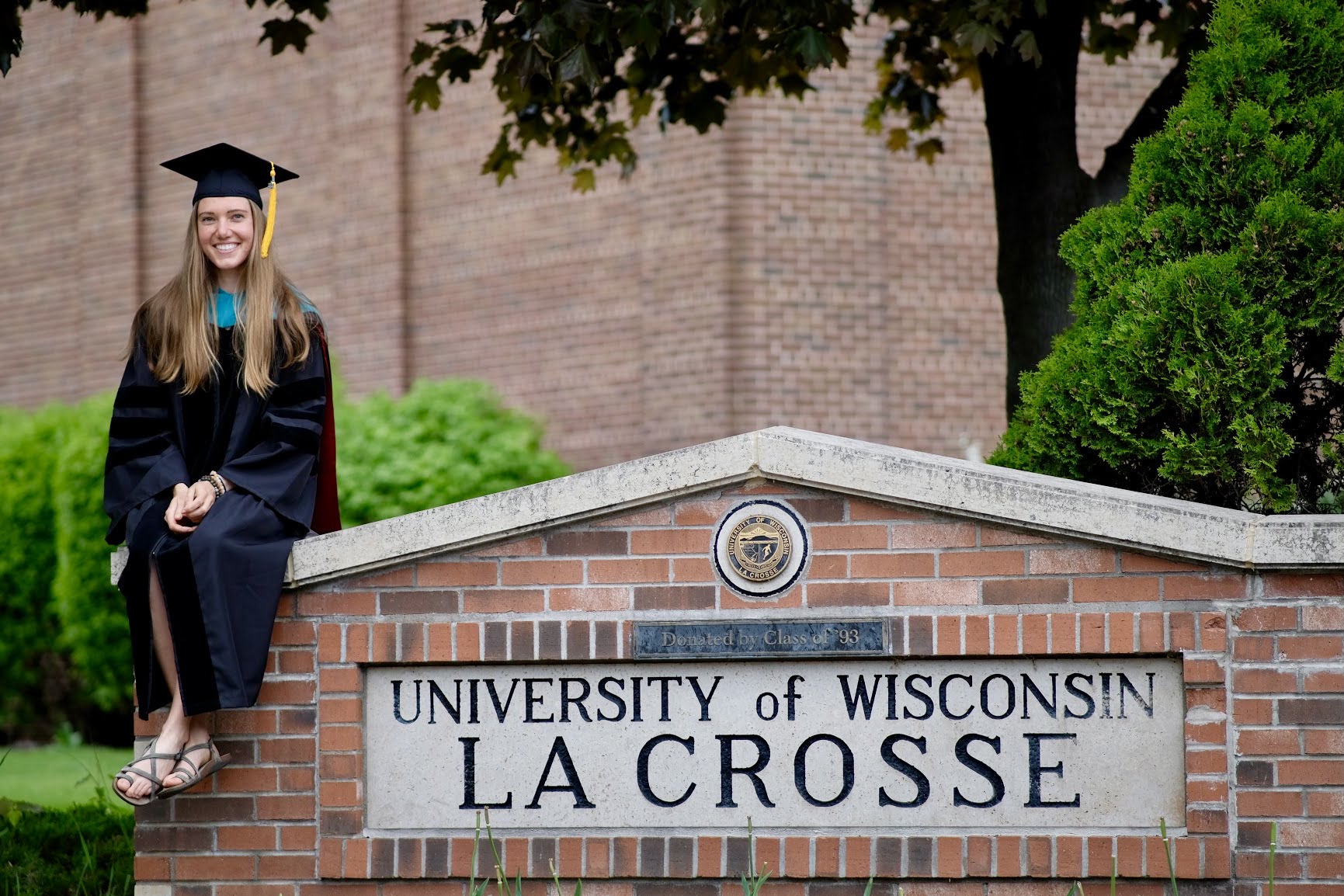
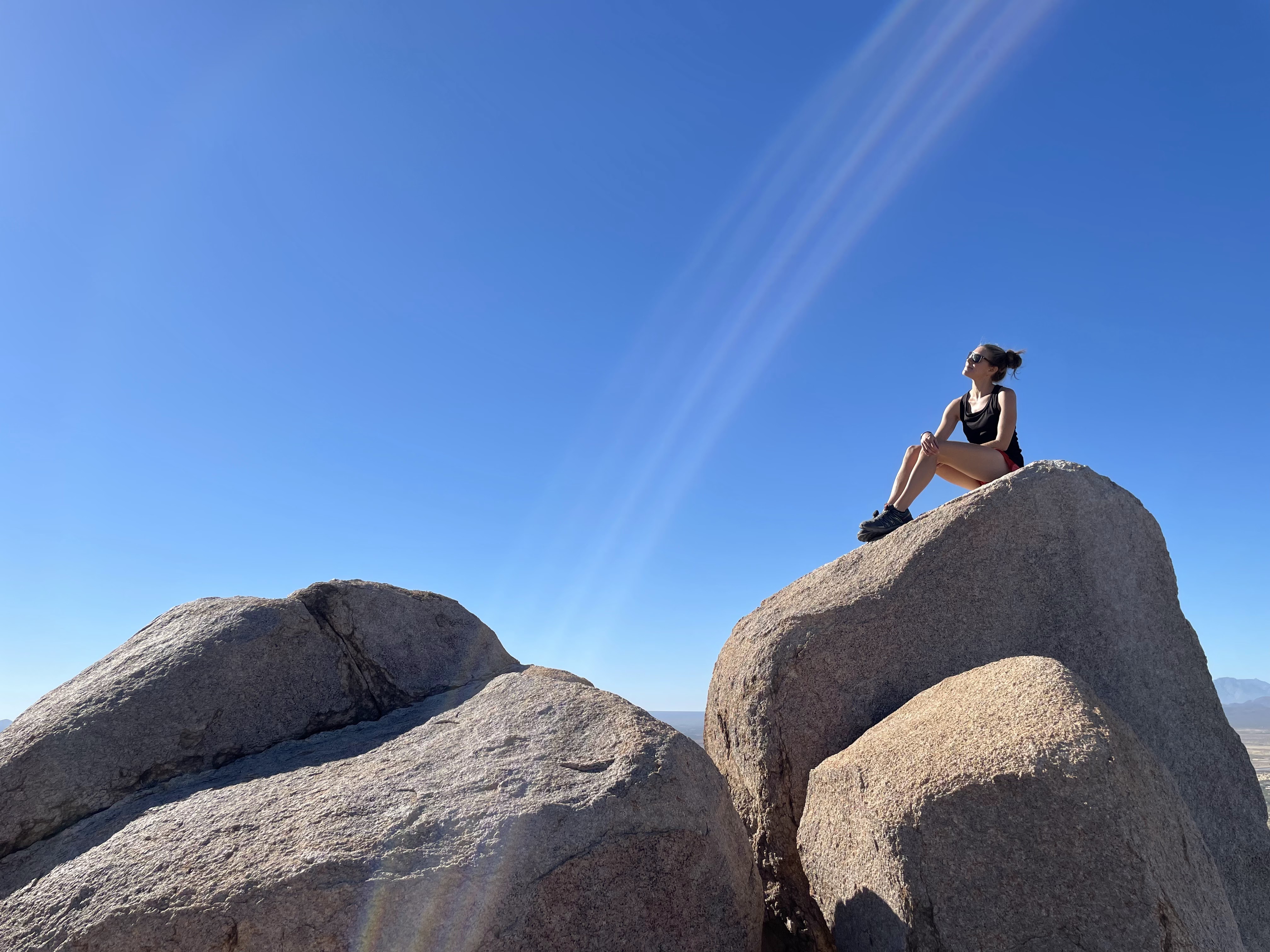
The most notable achievement of 2021 was finishing a 20+ year journey by concluding my formal education and graduating with my doctoral degree in physical therapy. And better yet? Even before I even graduated in May I had a job. My instructor from my final clinical in Seattle connected me with one of her past employers at a hospital in Yuma, Arizona. After an email, a phone call, and an interview, I was hired! Once again I packed up the trusty Subaru that was now officially mine and drove down to Arizona to start a nine month contract from September through May taking care of the seasonal residents of the Southwest. This would be the first of many travel contracts.
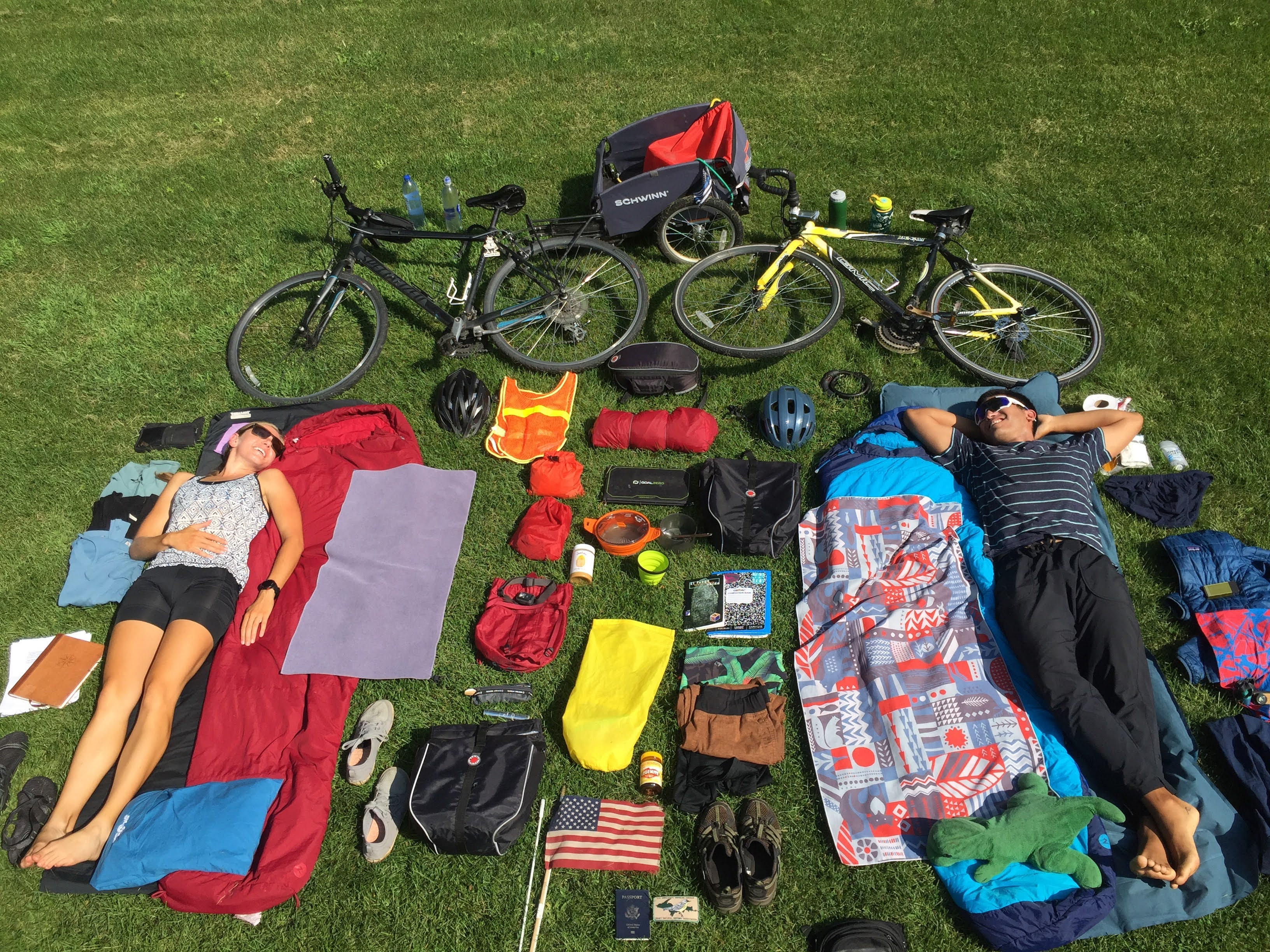
Although I had technically entered the working world, I still found plenty of time and ways to play! Prior to beginning my first job, I took the Summer off to do what I love most; adventure outdoors. I started road tripping back to Wisconsin from Washington and ended with a one month bike tour around the Great Lakes accompanied by a seasoned biker and good friend. The bike trip was my first long distance bike tour, but also marked what would become my longest romantic relationship, opening the door to places, people, and adventures I’d never dared to dream of.
2022: The Year I Returned to the Pacific Northwest

After a nine month stint in Yuma, Arizona I traded the sun of the Southwest for the rain of the Pacific Northwest. I left Arizona in May and started my next travel physical therapy assignment in the Oregon coastal town of Lincoln City in September. So what happened in between? With fresh funds in my bank account from nine months of work, I took Summer off and crossed a few more items off my bucket list.

The first and biggest adventure was a trip to Spain and Portugal over the month of June. I was excited to cross the ocean for the first time post-COVID and build on my Spanish that I had practiced while living on the US-Mexico border (I later learned the first language of Northern Spain is Gallego, not Spanish, but I still got to practice). I’m always excited to travel internationally, but the best part of this trip was that I got to spend the first two weeks with my mom and a few of our friends. Solo travel strengthens confidence, but travel with others strengthens bonds. We hiked over 60 miles through fields and villages on the Camino Portugues to end in the pilgrim hub of Santiago. I could easily spend a few more paragraphs telling stories from that trip, but this is already getting lengthy, so on we go to the rest of the Summer!

I spent most of July on the Oregon coast, trying to learn the frustrating art of surfing and enjoying time with the guy I left for most of the Summer. August brought a road trip through the Western states with a friend from the Netherlands that I met in Nepal 5 years before (had it really been that long?). We visited mutual friends we traveled with in Nepal, checked off some national parks, and added over 3,000 miles to my Subaru. This trip ended in Tomah where I joined my family on our annual trip to the North Shore of Lake Superior for a week of rest and relaxation which I was craving after nonstop Summer travels.
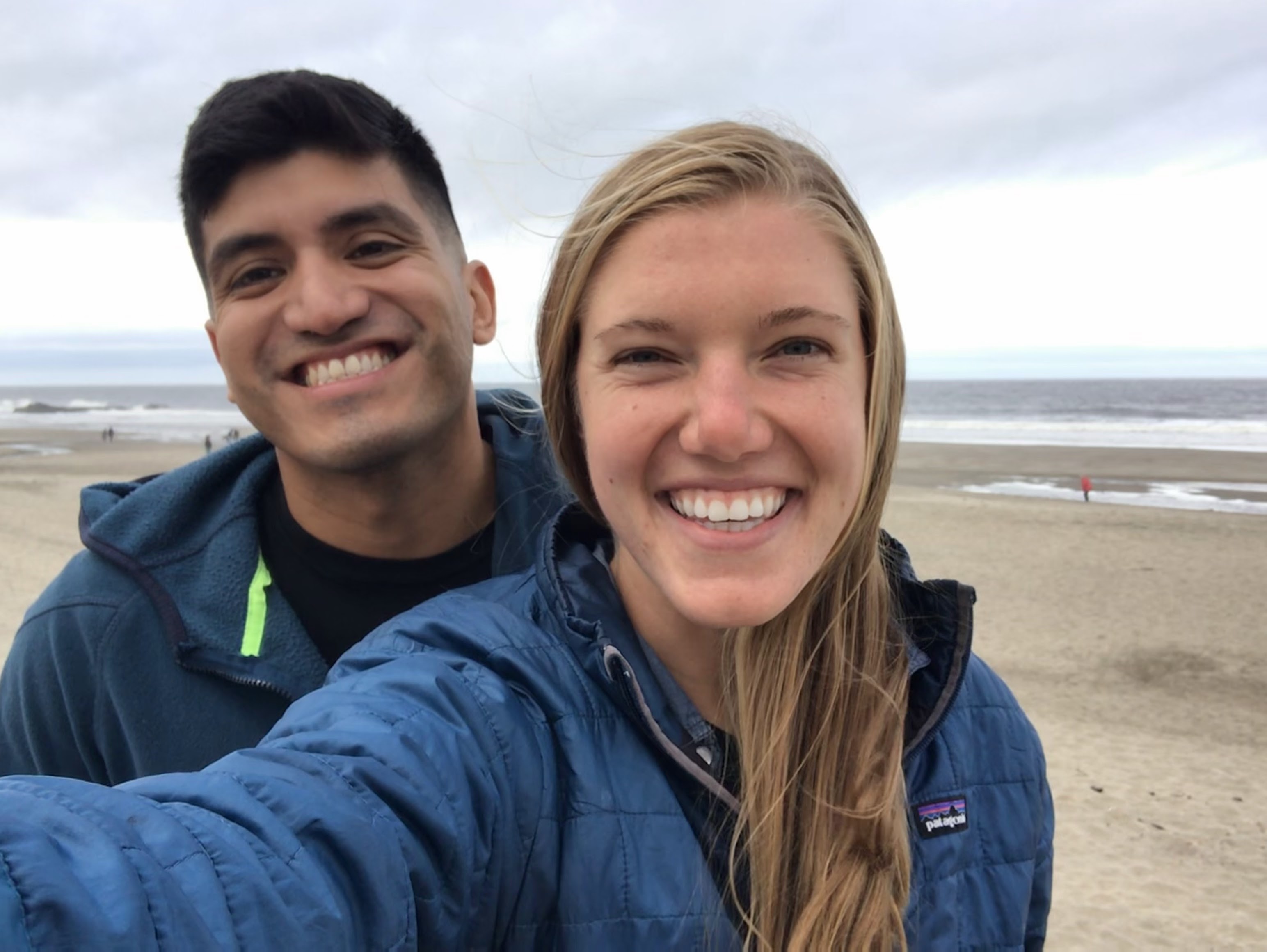
After some time with family, I drove back to the Pacific Northwest with my best friend for one last Summer adventure to the San Juan Islands and a drive down the Oregon Coast, the place I would be living. By September, I was back in Lincoln City, Oregon, looking forward to the routine of a nine to five job and the paychecks to replenish my bank account. Here I would stay for four months, living in a small coastal town alongside the one I love.

2023: The Year I Stayed Put (sort of)

Since the beginning of 2023 my home base has been in Portland, Oregon where I have been working 3-4 month physical therapy contracts in the skilled nursing and acute care settings. However, I haven’t exactly “stayed put” during this time. Thanks to nature of my travel work, I have time between contracts for local travels to places like Havasu Falls in Arizona, Powder Mountain in Utah, the Smokey Mountains in North Carolina, and an RV road trip around the Western States with my high school friends to celebrate our 10 year high school reunion. During my Portland contracts I get out on the weekends to explore the Pacific Northwest with both friends and family.
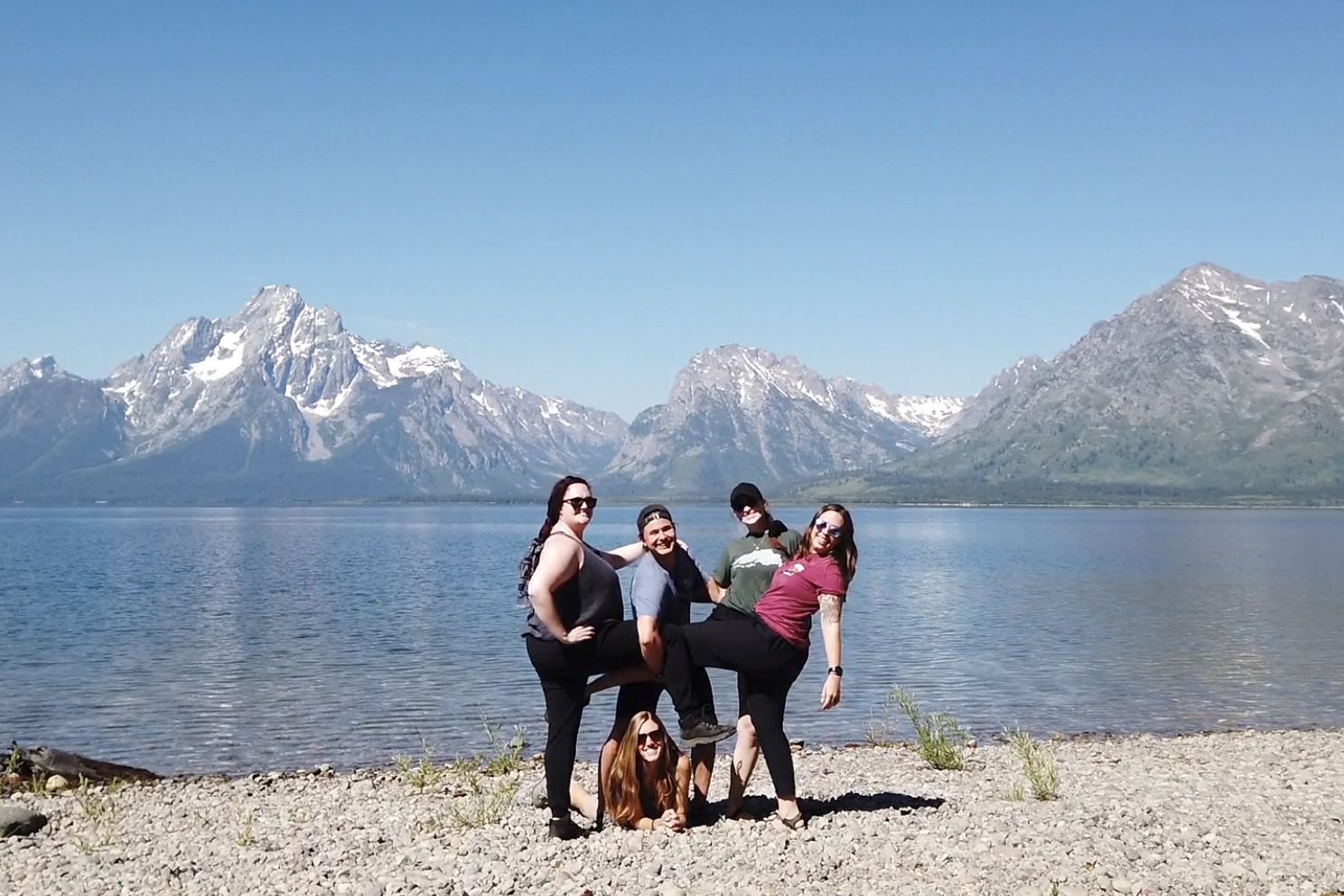
At the end of 2023 my international travels brought me to Guatemala where I was lucky to have an expert local guide as my partner Raul grew up in Guatemala. Here we hiked a Volcan de Acatenango, watched volcanic eruptions from Volcan de Fuego at sunset, swam in Lago de Atitlan, and ate muchos huevos con frijoles y tortillas. I also got to know Raul’s family and friends in Guatemala that do not all have the leisure of traveling the world as those of us with U.S. passports do.

Before returning to the U.S. I made a small detour to Santiago, Chile where I good friend who I met in Nepal was living. During the weekdays she gave me a list of places to explore around the capital and on the weekends we ventured to the coast, the colorful port city of Valparaiso and the little surf town of Pichilemu. She told me my next visit to Chile we would venture South into the Patagonia region. As with everywhere I visit, I returned with an even longer list of places for future travels.

And what about 2024? Thanks for asking! I will have some fresh blogs coming your way filled with stories of hiking among giants and lying low with the cats of Tuscany. Stay tuned!
Balloons Over Laos

IMG_2143.JPG

I sat on a bench outside my hostel at 5:00am. The town of Vang Vieng around me was completely dark and silent. I was patiently waiting for a tuk tuk to take me to the launch field where in a couple hours I would hop in a giant basket and take my first ever hot air balloon ride.

Before this trip, I didn’t have any particular interest in hot air balloons. I’d never seen them advertised in the Midwest and didn’t know anyone who had ever been on one. The hot air balloon rides I had heard of were in the Southwest and ridiculously expensive, with the cheapest ride costing over $200. However, when I was told about the $90 hot air balloon flights in Laos, it was on my list. In fact, it was the only thing on my list for Laos.

As luck would have it, our route passed through the town of Vang Vieng, a backpacker hangout in Laos roughly equivalent to Thailand’s hippy paradise of Pai. The town was known for its striking limestone karst hills, extensive cave systems, and crystal clear lagoons. Vang Vieng also happened to be the place rumored to have Asia’s cheapest hot air balloon rides. This was proven to be true when we arrived at our hostel which advertised the $90 hot air balloon experience. They offered a shuttle service from the hostel to the launch field and had flights everyday in the morning and evening. I didn’t need to know anything more. I was already sold.

IMG_2331.JPG

I waited until our last morning in Vang Vieng to go on my hot air balloon ride. I figured morning would be both the clearest and the coolest. Plus, what better way to end my four days in Vang Vieng than by floating over the town I’d grown to love.

However, by 6:30am I was beginning to wonder if I was actually going on a hot air balloon ride. It was normal for transportation in Laos to be delayed, but an hour and a half was pretty late. I wasn’t able to contact the company on my phone, so I reluctantly knocked on the door to the staff sleeping quarters. The owner of the hostel emerged, still groggy. I showed him my ticket with a 5:00am pick up time for the hot air balloon ride. He perked up, dialed the number of the company, and handed me his phone. When a man on the other end picked up, I asked, “Are you coming to Jenin Hostel? My ticket says pick up time was 5:00am.” They assured me they were on their way.

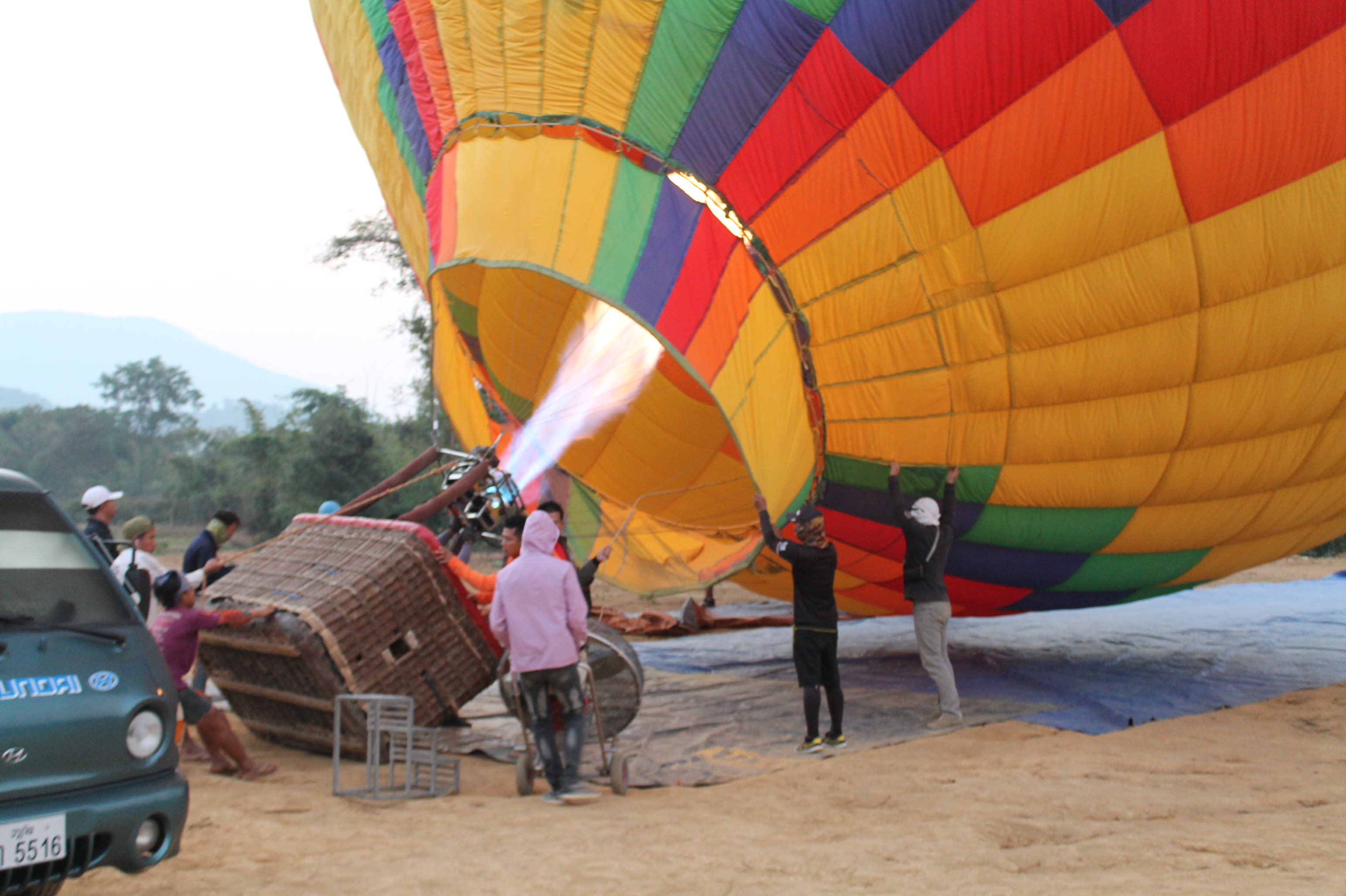
When I hung up the phone, the owner was awake enough to piece together what was going on. He didn’t know much English, but I gathered that I was supposed to go out back to the large parking lot behind the hostel. I walked out back and, sure enough, there was a hot air balloon being inflated just a few hundred feet from where I had been waiting for my ride. I didn’t need a ride, I just needed to walk into the backyard! I gathered with the other tourists to watch as the burners inflated the giant nylon balloon that would eventually carry us up into the sky.
Or so I thought.

IMG_2139.JPG

As I was snapping pictures, a young Lao guy approached me and asked to see my ticket. I showed him and watched his eyebrows raise. He said something in Lao to another man standing nearby. The two conversed and then motioned me to follow a third guy. Confused, but completely trusting, I followed the guy out of the parking lot, back through my hostel, and into the back of a pick-up truck. Without saying a word, we sped off to the outskirts of the town where I was dropped off at another launch where another hot air balloon was just finishing the inflation process. They checked my ticket and gave me a nod of approval. I breathed a sigh of relief. Never a dull moment.

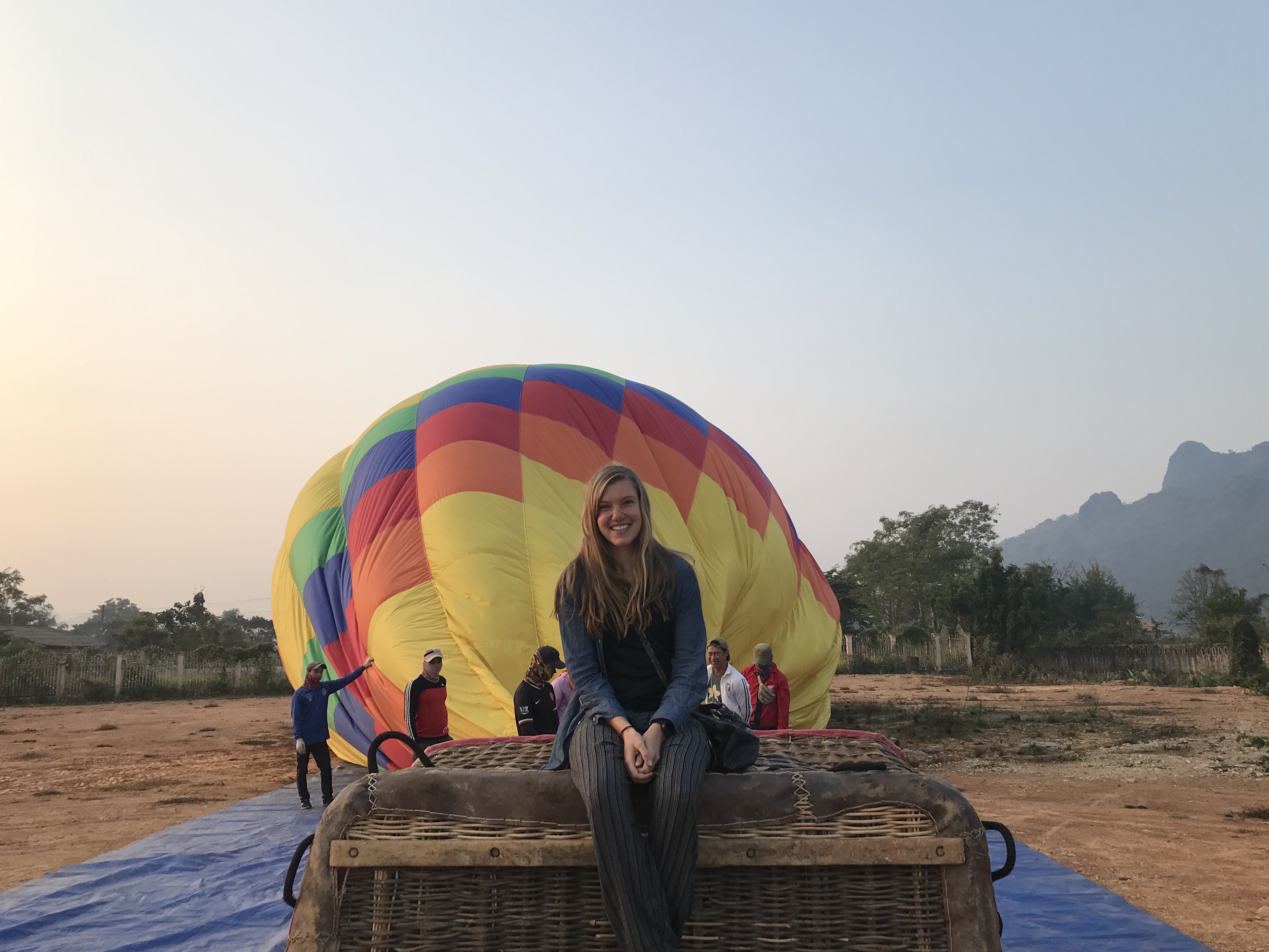
Within minutes after I arrived, I was climbing up into the basket with four other tourists plus a pilot and copilot. The pilot spoke English quite well and instructed us not to touch the burner or any of the lines. When the hot air balloon landed, we would crouch down to prepare for impact. That was the safety briefing. No waivers, no contingency plan, no questions… No surprise, really!
IMG_2394.JPG

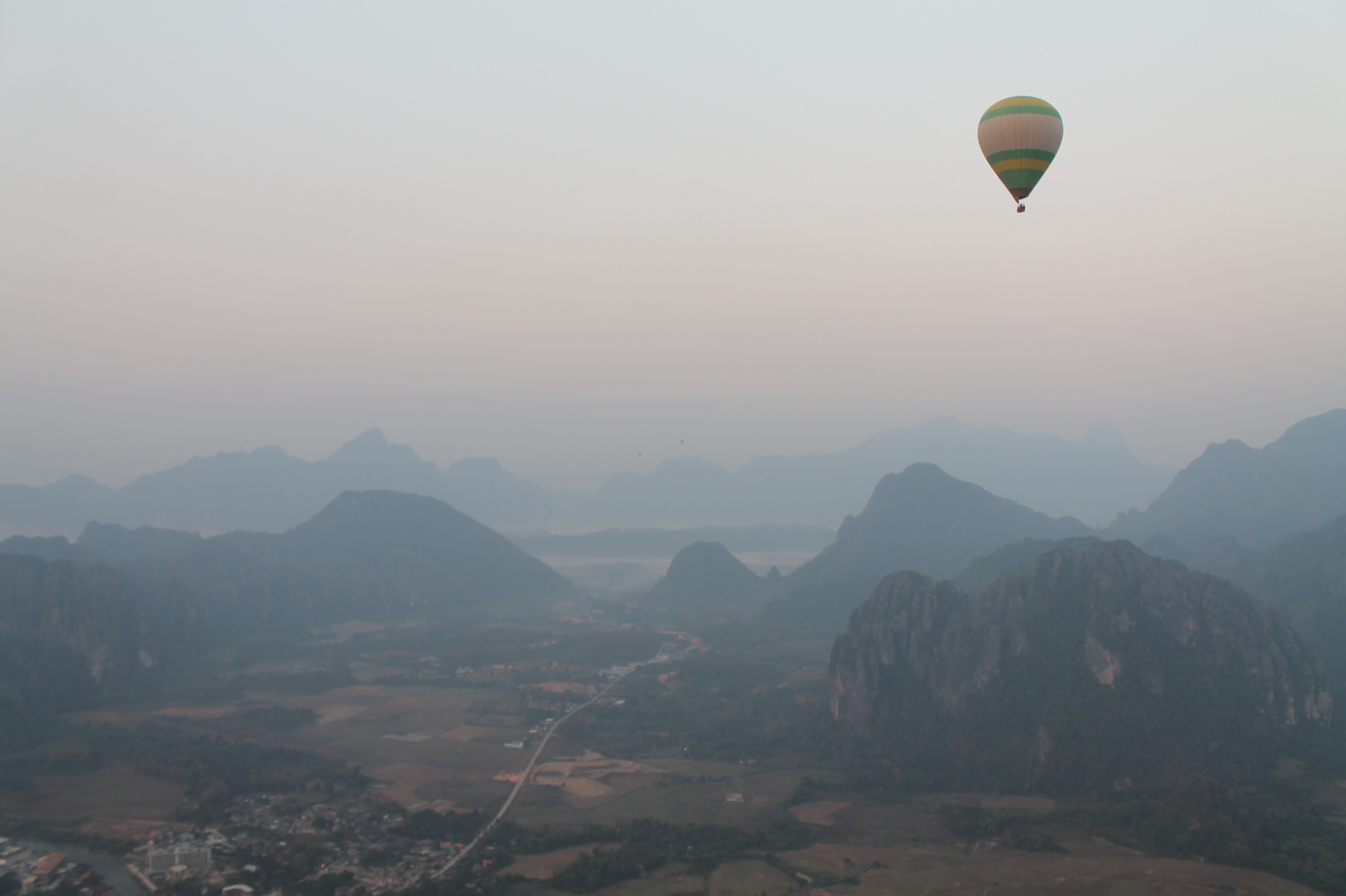
I’m not afraid of heights, nor had I been apprehensive about the hot air balloon ride, but as the men around me released the basket and we began to lift off the ground, I felt a small knot in my stomach. As we cleared the trees at the edge of the launch, my stomach eased and I felt a smile spread across my face. I was flying – no – I was floating above the ground. It was like my favorite part of takeoff on an airplane, but much smoother and with greater clarity.

What they didn’t tell us was that contrary to how they look as they serenely float through the sky, hot air balloons are not quiet. In order to keep the balloon afloat, the pilot needs to occasionally run the burner. It went from near perfect silence to a loud release of hot air being blasted into the balloon that produced a wave of heat that washed over our heads. This startled me the first couple times, but as we drifted higher into the sky, I forgot about the noise.

It was beautiful. Every direction I looked had me transfixed. Gone was the noise of the traffic, the mangy stray dogs, the trash in the street, the hardships of daily life. Floating 2,000 ft above, everything looked perfect.

IMG_2150.JPG

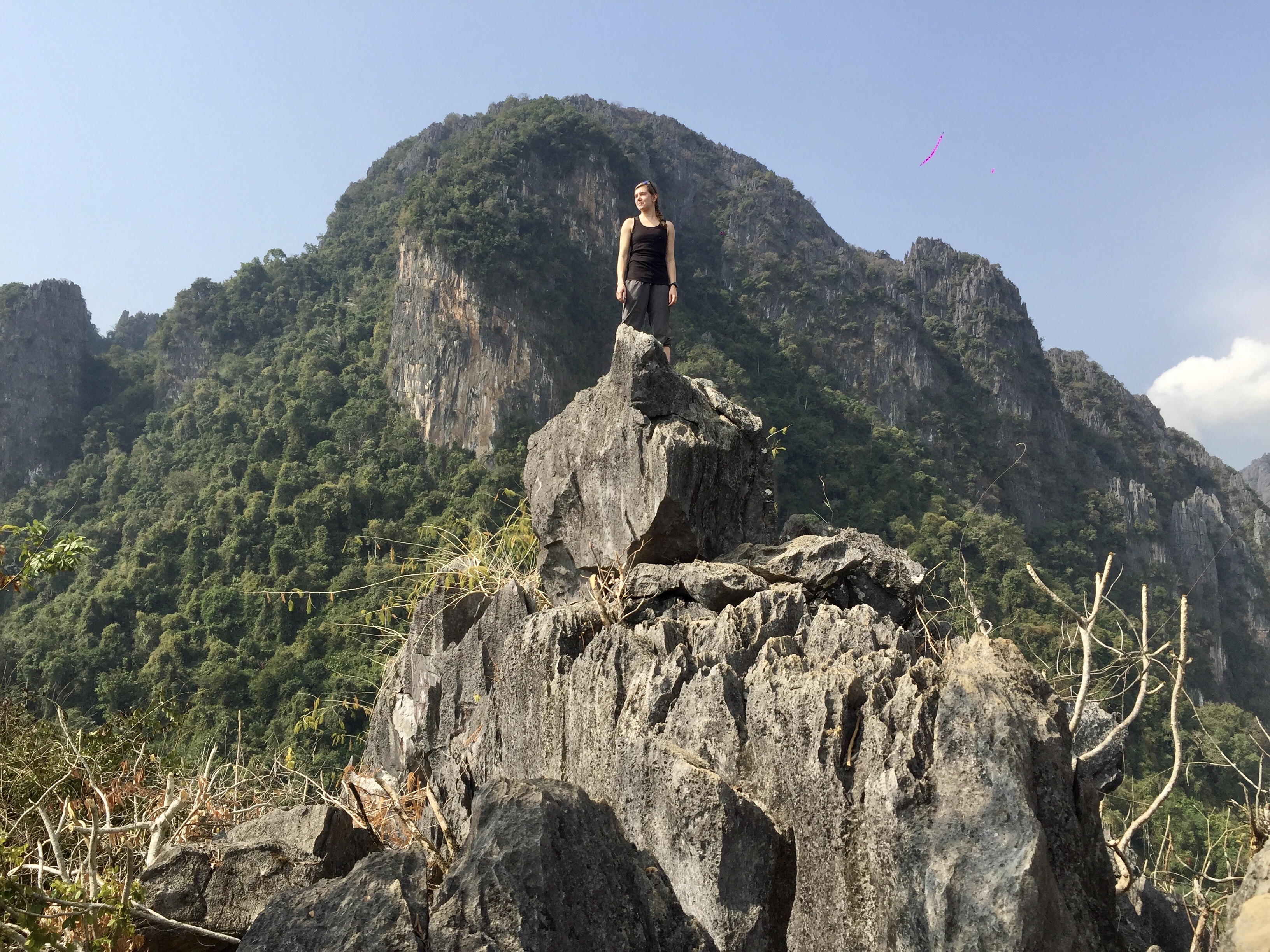
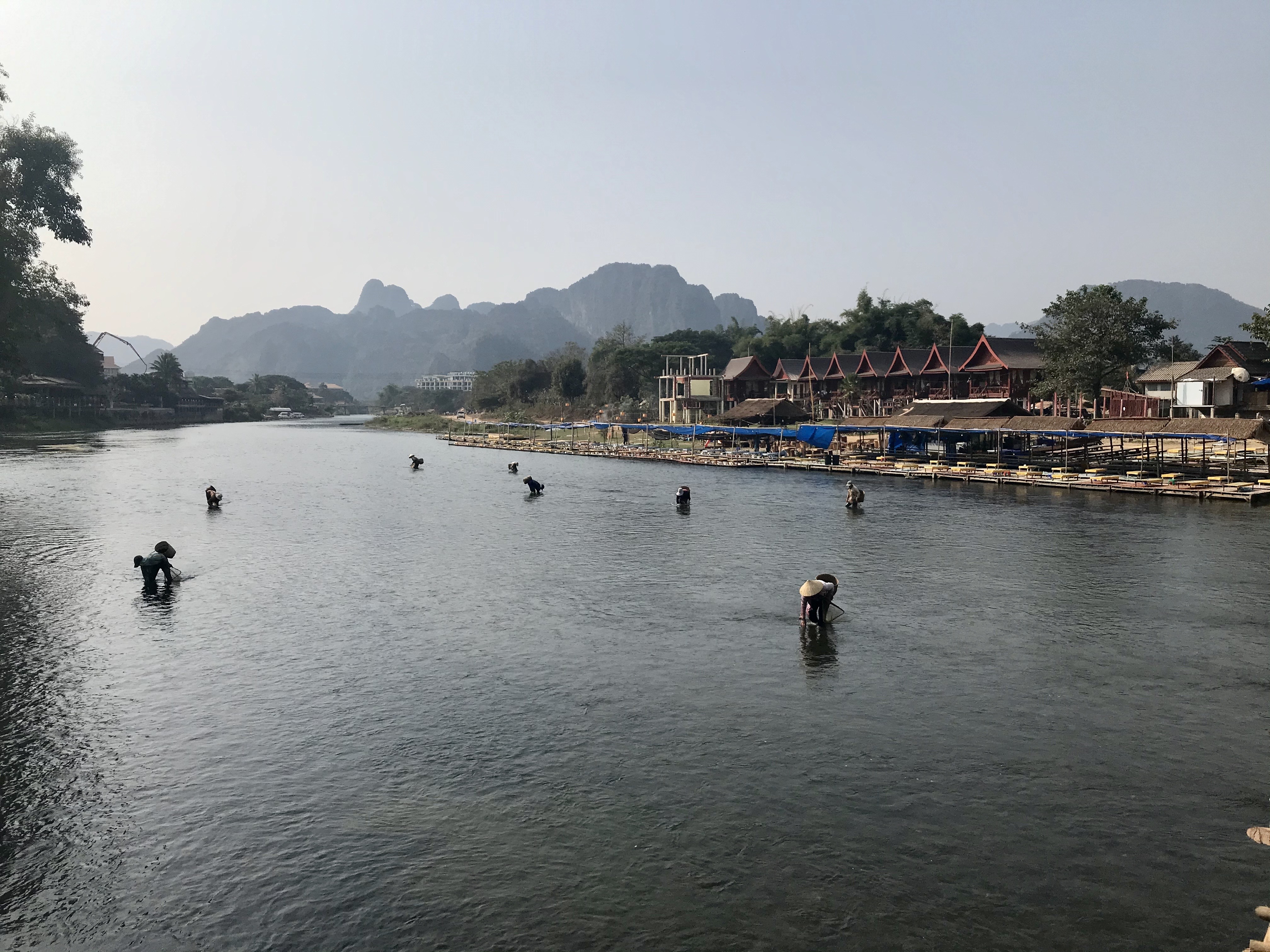
I saw all the same things I’d seen over the past four days, but they were different. There was Phapoak Mountain that we had scrambled up on our first day in Vang Vieng. It had taken us half an hour of hard climbing to get to the top, but the mountain looked like a molehill from the sky. Although I couldn’t see them, I knew that hidden in the mountain and surrounding hills were dozens of deep caves housing statues of Buddha and other spiritual relics. I could see the Nam Song River that we had spent hours tubing down the day before. It appeared gentle, but I knew there were plenty of rocks beneath its calm surface. And there was the construction China-Laos Railway, a great advancement in Laos transportation that will simultaneously strengthens China’s grip on the small landlocked country. A gift from China, to China.

All too soon, our pilot told us we were beginning our descent. We had been floating half an hour, but it felt like minutes. As our balloon came down, things came into focus. It was 7:30am and the town was waking up. Shop owners rolled up the front gates of their stores and food vendors wheeled their carts down the street. As they physically prepared for another day of work, I mentally prepared to leave; not only to leave Vang Vieng, but leave Laos, and eventually leave Asia.

All good things come to an end. But if that’s true, all good things must come to a start too. Although my month of travel in Thailand and Laos is coming to an end, on the horizon is a new adventure. This May I will pack up my six years in La Crosse and move to the East Coast to begin a series of physical therapy clinicals. Like my travels of the past month, I will undoubtedly make mistakes, learn, and grow. And like my travels of the past 25 years, I will always find time to get out and explore!

IMG_4096.JPG

Do You Remember?

IMG_2429.jpg

Do you remember when we used to talk to one another?
When conversations took place on the sidewalk rather than on an app,
And we looked into each other’s eyes rather than into a screen.

Do you remember when we wandered around with nothing but a paper map?
When we got directions from a shop owner rather than a GPS,
And asked our questions to other people rather than Google.

Remember when we captured moments through our eyes rather than a lens?
When there was no need to share everything we did with the world,
When our own approval was enough.

Remember when we used to get letters instead of likes?
Or made memories instead of posts,
Friends instead of followers.

Do you remember these things?

Because I’m starting to forget.

Slow Boat to Laos

Two days traveling down the Mekong River into a country that appears sunny and serene, but has a dark and devastating past.

IMG-2305.jpg

It had always been the plan to cross the border of Northern Thailand into Laos. However, Laos had always seemed so distant that I hadn’t done any research on how to cross the border or even what we would find once we crossed it. Like most of the trip, the plan was to figure it out along the way.

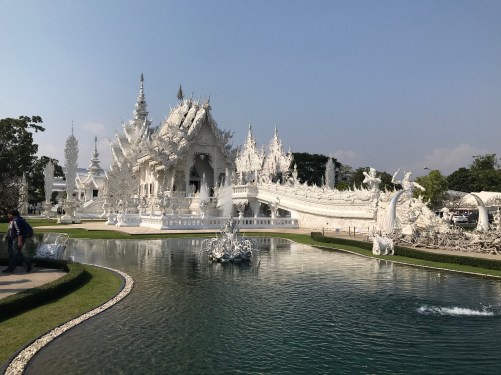
After two weeks of traveling North through Thailand, we found ourselves in Chiang Rai, the gateway city for backpackers traveling to Laos and Burma, the two countries that form the Golden Triangle with Thailand. Chiang Rai was a relatively lackluster city after all the excitement of Pai. Though there were plenty of gorgeous wats & architecture with colorful names (White Temple, Blue Temple, Black House), the natural attractions and parks were outside the city.

We decided to spend just one day in Chiang Rai to explore the city, do laundry, and figure out how to get to Laos. Laundry and finding information on crossing the border was surprisingly simple – our hostel offered both services! After chatting with the owner of the hostel, we discovered there were three ways to cross into Laos: land, water, or air. Since we were on a budget, flying was ruled out. That left bus or boat as our transportation options. Over land would take 14 hours and a sleepless night on a sleeper bus. The slow boat, on the other hand, was a two day journey traveling on the Mekong River for seven hours each day and stopping to overnight in the riverside village of Pak Beng. Though bus was faster, the slow boat into Laos seemed the obvious choice. We booked our transport across the border into Laos and the boat ride for 1,650 Bhat ($55). Trip planning here is almost too easy!

IMG-2268.jpg

After we’d booked our ticket and done laundry, all that was left to do was explore the city. Following the advice of other travelers, we hopped a local bus to see the White Temple, a stunning piece of modern art mixed with traditional Thai-Buddhist architecture. We wandered around the temple, grabbed some lunch, and waited patiently for a tuk tuk ride back to city center. In the city we wandered in and out of shops and investigated the night market, which was good, but not as good as the street food in Pai.

A full day in Chiang Rai was enough.

The next morning our bags were packed and we were standing by the door of our hostel at 6:00am. The owner of the hostel had very kindly backed us paper bag lunch the night before complete with banana pancakes, bread, bananas, and a hard boiled egg. I bought a couple sweet roti from a local food stand and a jar of fresh ground peanut butter from our hostel. Plenty of food for the day!

Forty minutes later a small white car pulled up and a small Thai woman with short hair hopped out and quickly loaded our bags in the trunk and ushered us into the car. She spoke no English, and we spoke no Thai. Like so many times before, we trusted that she would take us to the right place. We assumed that she was taking us to a bus station that would transfer us to the border of Laos. However, as we left the city limits of Chiang Rai, we realized that we were going the whole two hour journey by private car. You really never know what you’re going to get here.

We arrived at the Thai Border Control where we were stamped out of Thailand and quickly escorted to a bus waiting to take us to Laos Immigration. Before we left, our private driver took a quick photo of each of us passing through border control, likely looking quite dazed & confused. She waved goodbye and headed back to Thailand.

Everything else ran quite smoothly: we rode a bus over the Mekong River into Laos, paid our $35 visa fee, and were guided to a series of tuk tuks that eventually took us to the boat landing in Huay Xai where we were given our tickets for the two day journey by slow boat down the Mekong River. We boarded our boat just before 11:00am and got comfortable. Or tried to get comfortable. The seats were wooden benches placed so close together that our knees knocked the bench in front. On top of that, we discovered that the benches weren’t bolted down so every time we moved, our seat moved too. This was going to be a long ride.

IMG-2279.jpg

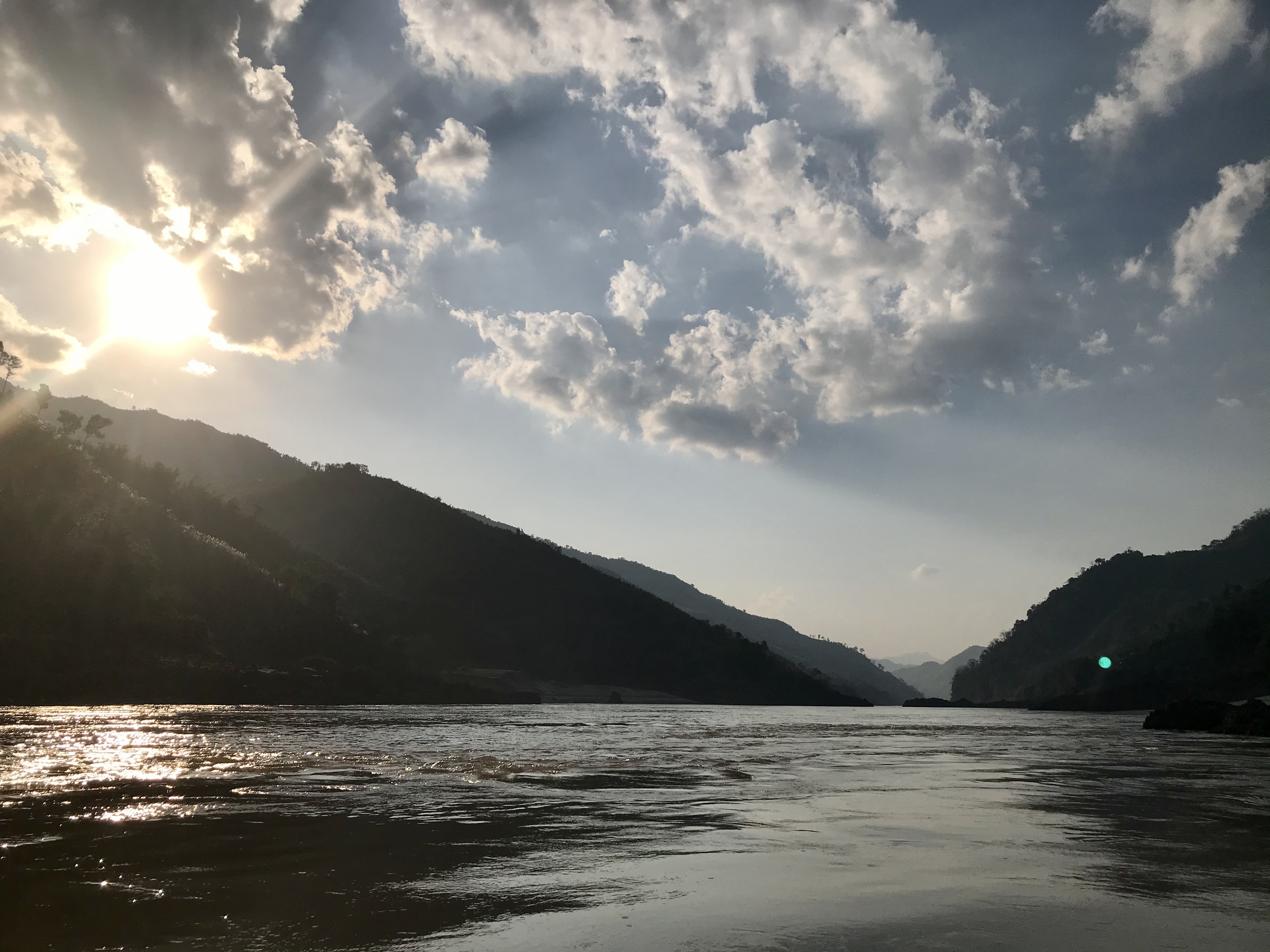
However, as our boat pulled away from the port and started traveling down the river deeper into Laos, we were distracted from the discomfort by the scenery. Soon the flat sandy shores began to rise and foothills appeared upon the horizon. Jagged tan rocks jutted out from the water, posing as treacherous obstacles if our boat ran off course. Local villagers gathered on the shores with nets and in fishing boats. Children bathed and played in the river while their mothers washed clothes. I was also kept distracted by a couple lively gals from the UK who were traveling the world for a year. They were full of great stories from previous adventures in Canada, Mexico, and Central/South America.

A few hours into the trip we passed by a man waving a yellow flag and calling out to our boat driver in Lao. We pulled over to the shore to wait for the unknown dangers ahead to clear. After multiple translations of the story in something like a game of international telephone, we found out that a power line was down and strung low across the river. A couple local long boats were able to hoist it up using a few long sticks and our boat was able to safely skim under the line and continue the journey to Pak Beng, our resting spot for the night.

IMG-2284.jpg

We arrived at the village just before sunset and were immediately bombarded with young men trying to market various local hotels, restaurants, and bars. We had already booked a hotel at the boat dock in Huay Xai so we simply found our hotel’s tuk tuk and went a few minutes up the road to a simple hotel with a nice view of the Mekong River.

We dropped our bags off in our room and went to the dining area to find a real meal (the bread, bananas, and pancakes were good, but not substantial). We asked the hotel owner what he recommended for our first meal in Laos and he told us we needed to get the koy with sticky rice. I asked if he could prepare it with tofu or vegetables instead of buffalo/chicken/pork. He looked at me like I was crazy and said “no” (later I would find out that koy is also known as laap which translates into “meat salad”). I swallowed my vegetarian pride and told him chicken would be fine. In truth, I’m not a strict vegetarian, especially when traveling abroad.

We sat on the patio by an Italian gentleman and a group of French folks that were also traveling on our boat. We grabbed some BeerLao and chatted with our fellow travelers while we waited for our meals to come. Soon they placed in front of me a heaping plate of minced chicken with garlic, mint, cilantro, lemongrass, and a host of other spices. Along side was a little basket of sticky rice. We were instructed that to enjoy this classic Laos dish the traditional way, we were to pull apart the sticky rice with our hands and use the rice to pick up the meat. No utensils needed. Not only was the koy & sticky rice delicious, but it was fun to eat with my hands! Not something I could do in a restaurant back home.

IMG-2298.jpg

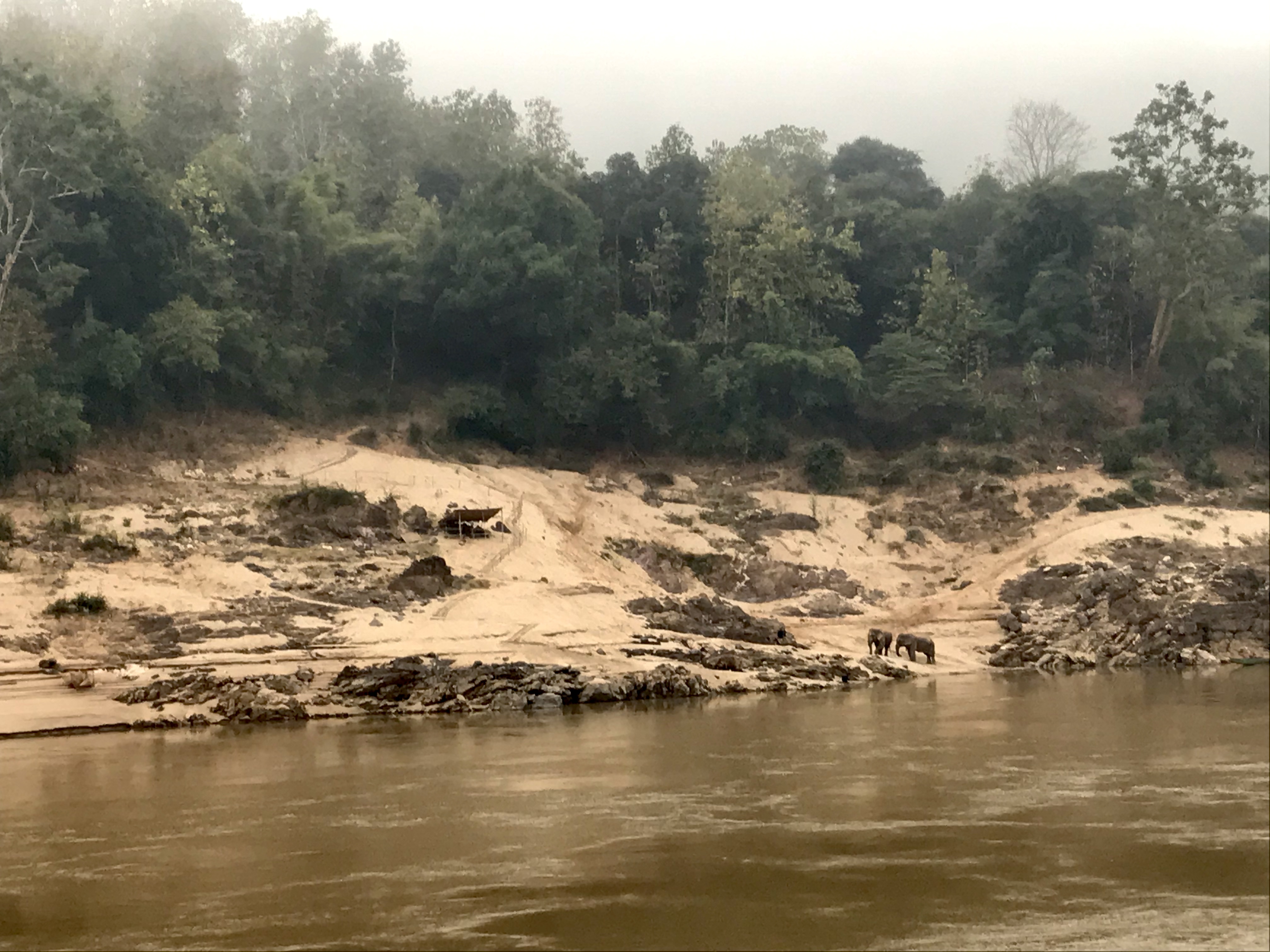
The next morning I woke before 7:00am to see the elephants come down from the Mekong Elephant Park across the river. I filled my thermos with tea and made my way through the tall grass and out onto the rocky banks of the Mekong River. As I stood and sipped my tea, two elephants were led down to the water by two young mahouts. The elephant trainers lounged waiting for the elephants to put on a show for the tourists watching on the opposite bank. However the elephants weren’t interested in the river or the tourists. Almost in defiance, they turned their large rear ends toward the river and waited to go back into the forest where there was plenty of food and water. One elephant expressed his opinion by taking the opportunity to relieve himself in the river. The scene was not anything out of National Geographic, but I found it pretty hilarious!

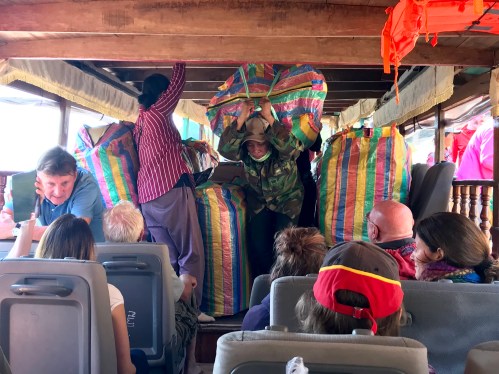
By 9:30am we were cruising down the river again. Today we had changed to a different boat and it was a major upgrade. The seats were recycled cushioned benches from old vans and much more comfortable. I had room to stretch my legs and even space to place my backpack under the seat in front of me. It felt like a first class cruise compared to yesterday! That is, until an hour into our ride when we stopped at a village dock that was packed with over 50 large pieces of cargo and passengers. I thought, there’s no way they can fit everything on this already full boat. But one by one, the people and packages were loaded onto the boat, some on the roof, some in the front, some in the engine room. The whole process took about half an hour, and by the end we were riding low in the water. But we were still afloat, so off we went!

IMG-2302.jpg

The second day passed quickly. I spent most of the time looking out the window and the scenery passing by, sometimes listening to music, but mostly enjoying the sounds of the boat, river, and people around me. I read a little, napped a little, and before I knew it, we were pulling up to the city of Luang Prabang, our final destination by boat. The sun was setting as they unloaded the boat and we made our way up the hill to catch a tuk tuk into city center and our hostel.

We had spent 14 hours traveling 185 km of the Mekong River into Laos. We’d seen a lot during our two days on the boat, but still knew very little about the country. We hadn’t yet swam in the unbelievably blue waterfalls and lagoons or scrambled up the limestone karst hills and into caves. We also knew nothing of the vast areas of land that lay untouched since the 1960’s when the U.S. dropped two million tons of bombs on the country during the Vietnam War – 30% of which never detonated.

But we would learn. The good, the bad, and the ugly. When you travel, you always learn.

IMG-2306.jpg

Slice of Pai

Carefully making my way over canyon spines, climbing up the rock faces of waterfalls, and learning to ride motorbikes… The kinds of things you don’t tell your parents until later.

IMG_2114.jpg

After four days in Bangkok, I was ready to leave the city and see the country. Don’t get me wrong, Bangkok was a fun city with it’s bustling street markets, rooftop restaurants, and wats (temples) on every corner. With simple, accessible public transport, I had no problems traveling solo throughout the city. I grew confident in my last couple days and stayed out past dark, feeling completely safe as I made my way back to my  hostel by metro. There was still plenty of the city I could explore, but I would be back in a few weeks. It was time for a change of scenery.

I hopped a train to the airport just outside the city where I met my travel buddy, Bastian. We had met backpacking the Annapurna Circuit together in Nepal and were ready to take on Northern Thailand and Laos. However, this was a different style of travel. Rather than putting in dozens kilometers on foot over a backpacking trail, we would be putting in hundreds of kilometers via plane, bus, and boat getting to various cities on a popular backpacker route (known as the Banana Pancake Route). We would spend just a few days in each city, sampling the culture, food, and scenery before moving on to the next. We would head North, planning as we went, getting advice from other travelers along the way. A new style of travel for me, one that promises spontaneity and adventure!

IMG_2114.JPG

On New Year’s Eve we flew up to Chiang Mai, just in time for the floating lantern celebration. Hundreds of paper lanterns were launched into the sky throughout the evening, with a huge flood of lanterns released at midnight. Some floated dreamily into the night, others quite literally crashed and burned. A bit of a fire hazard? Probably. A unique way to bring in 2020? Absolutely!

Our next couple days were spent exploring the mountains surrounding the city. There are several ranges in Northern Thailand, but in general they are collectively referred to as the Thai Highlands. They are relatively low elevation, with the tallest, Doi Inthanon, only rising 2,565 m (8,415 ft) above sea level. The Thai Highlands are actually considered the foothills to the Himalayas, growing higher in Burma before stretching into India and eventually reaching Nepal. Someday I’ll follow them back to Nepal. Maybe in a couple years. But it’s impossible to plan that far in advance. You can try, but life is unpredictable and takes you to some unexpected places. Like Thailand and Laos!

IMG_2097.JPG

Chiang Mai, to my surprise, was a big city. The fourth biggest city in Thailand with over 174,000 residents and LOADS of tourists. So we continued North in search of something less busy and came across the town of Pai. This was one of the few cities that we had planned to visit on the trip. Other travelers we met in Nepal had raved about the beauty and solitude of this little backpacker village. It was off the main route North, but we were assured it was well worth the detour. And it was.

We arrived to Pai in the afternoon after a 3 hour drive through winding mountain roads. We dropped our packs at our hostel and walked into town. Exploring the actual village of Pai doesn’t take long; it has just one main walking road and a few side streets lined with shops and restaurants. Nothing too impressive. Until the sun set.

IMG_2320.jpg

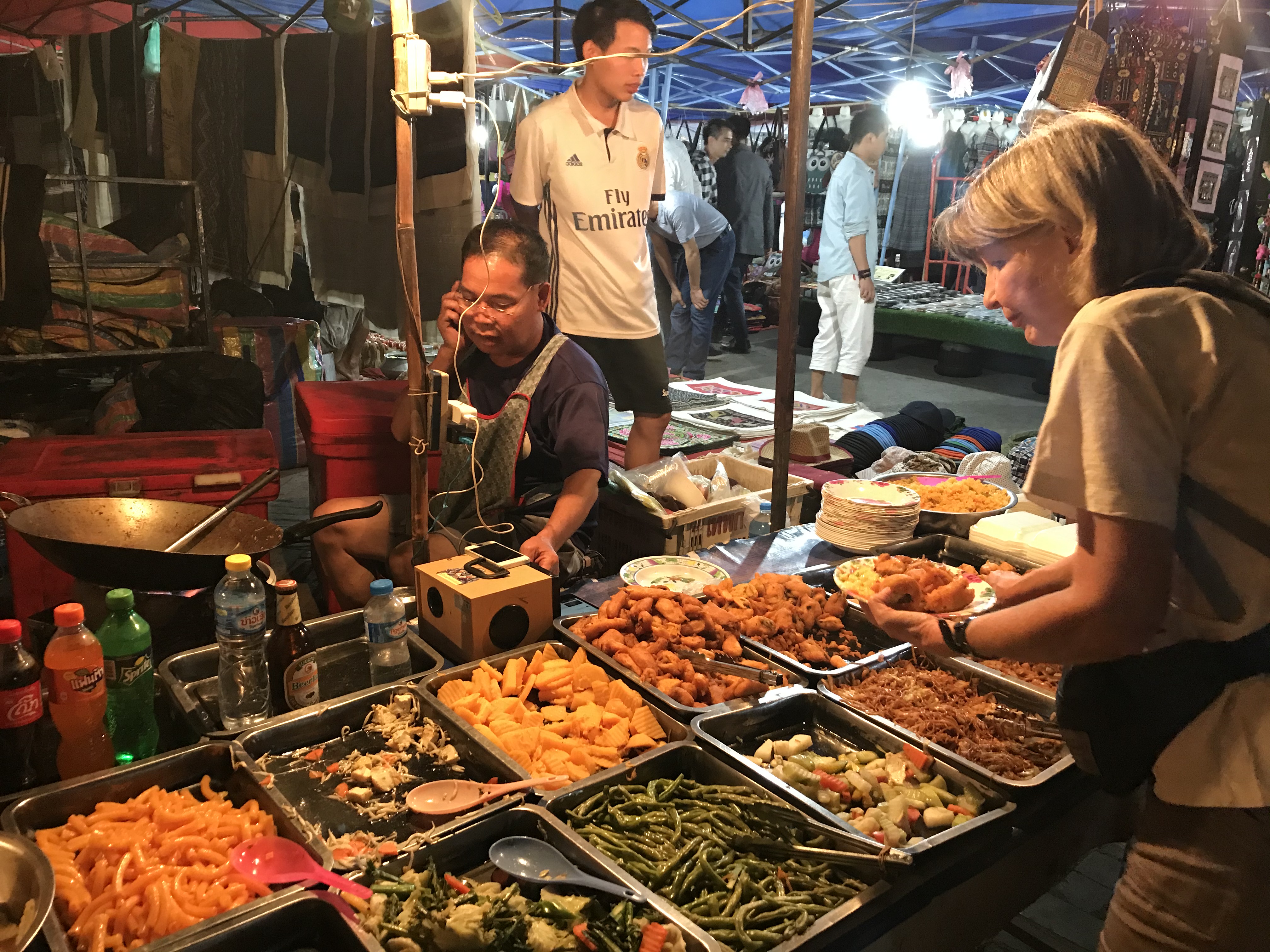
Starting around 7:00pm the main road was closed off to vehicles and street food stands began to pop up. There was typical Thai food I’d encountered in Bangkok & Chiang Mai: pad thai prepared in a large wok, fried roti with banana, fresh fruit smoothies, and all sorts of barbecued fish & meats. But there was also foods from all over the world: Indian curries wrapped in naan bread, Mediterranean hummus & falafel in pita, huge slices of avocado on French baguettes, and a wide assortment of teas served in tall bamboo shoots (a personal favorite). We spent hours wandering through the streets of the night market, sampling all sorts of foods and observing all sorts of people (Pai attracts some colorful characters). This would become a nightly routine during our three days in Pai.

For our first full day in Pai we had one goal: learn to ride motorbike. I hadn’t intended to rent a motorbike during my travels. I didn’t know how to drive motorbike, and I didn’t have a motorbike license, let alone an international driver’s license. Oh yeah, and motorbikes are dangerous. Especially having to drive them on the left side of the road. Traveling by motorbike seemed out of the question.

However, the more travelers I talked to, the more told me that it was an essential experience to ride a motorbike when traveling Southeast Asia. It’s cheap (usually $6 for 24 hours) and allows you to see more of the country. They told me it didn’t matter that I had never operated a motor bike. Many of them had learned to drive in Asia themselves and told me as long as I wore a helmet & was a smart driver, I would be fine. As far as the license goes, most people don’t have licenses. If you get pulled over, you pay the 400 bhat fee (about $15 USD) and continue on your way. If you get pulled over again, just pull out your ticket to prove you paid the fee already. Easy.

Yet, I wasn’t fully convinced until I met another female solo traveler who had learned how to ride motorbike in Pai last month. She told me it was the perfect place to learn; a small town with wide paved roads and little traffic. She gave me the name of a rental shop where the owner will give you a lesson before cutting you loose on the roads.

So that settled it. I was going to learn to ride motor bike. I would tell my parents later.

img_7757.jpg

The motorbike rental shop, Vespai, was located on a quiet side street lined with a few hotels. When we arrived at 11:00am there were six people waiting for lessons and motorbikes. We were going to wait awhile, but when traveling in Asia, you learn to be patient. While watching the new riders troddle down the street, we struck up a conversation with a young gal named Emily from Australia who was vacationing in Thailand with her family. They had rejected her idea to go to Pai, so she decided to venture North solo while they stayed in Chiang Mai. I liked her already.

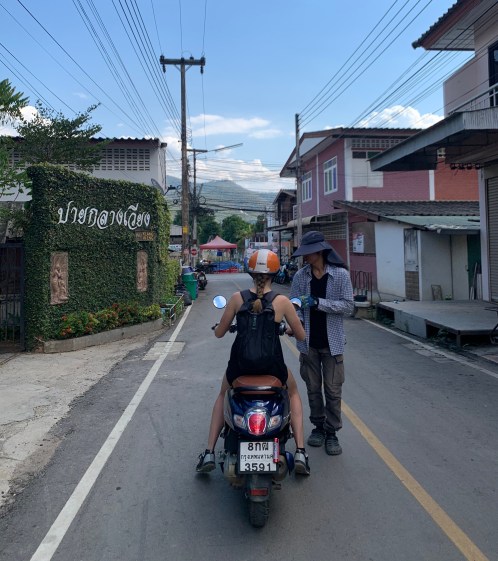
After an hour, it was just the three of us standing at the shop, and fortunately, three motorbikes left. By this time, I had watched quite a few lessons and was feeling good about getting on the bike. I knew how to work the ignition, brakes, turn signals, accelerator, and perform an emergency start. What else was there to know? After reacquainting me with the parts of the bike, I finally got on. We spent about 30 minutes learning to accelerate “slowly, slowly”, brake “slowly, slowly”, and turn the bike around “slowly, slowly”. Finally I was allowed to take the bike for a spin around the block. Amazingly, I made it all the way around. Going “slowly, slowly”, of course.

Soon Emily joined me in my circuits around the block, and eventually Bastian for just a couple laps (our instructor said he didn’t need as much practice because he was German and a man, so he catches quickly. Ugh.). The three of us pulled back up to the front of the shop for some final words of advice from our motorbike sensei: “Do not get overconfident. That is when accidents happen. Good luck.” And with that, we were cut loose to explore the streets of Pai and beyond.

img_8057.jpg

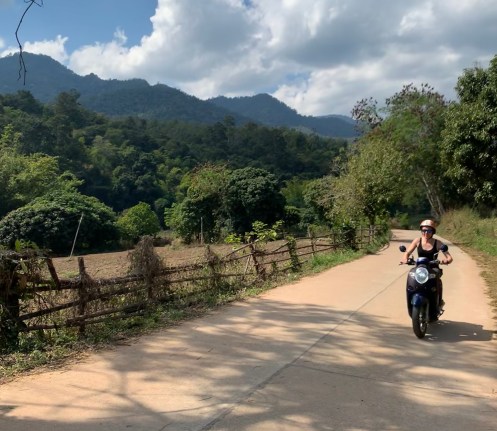
The three of us headed out on the main road, adrenaline pumping, riding toward some of the popular attractions just outside town: Pai Land Split, Pam Bok Waterfall, bamboo bridge, and Pai Canyon. We stopped along the way for lunch and found a beautiful vista overlooking the highlands. I could see roads weaving through the valley and felt a wave of excitement knowing that I was free to explore those roads with my motorbike. Ultimate freedom.

We turned off the main road and bumped along a smaller road leading towards the Land Split, waterfall, and bamboo bridge. We stopped along the way at a little pond with a few swings along the shore before finishing the short ride to the Land Split. This turned out to be a small canyon-like feature that was caused by several small earthquakes that had occurred over the past 12 years. We walked through the split, wondering out loud when the land would split again. Being located along the same fault line as the Himalayas, it’s only a matter of time.

IMG_2041.jpg

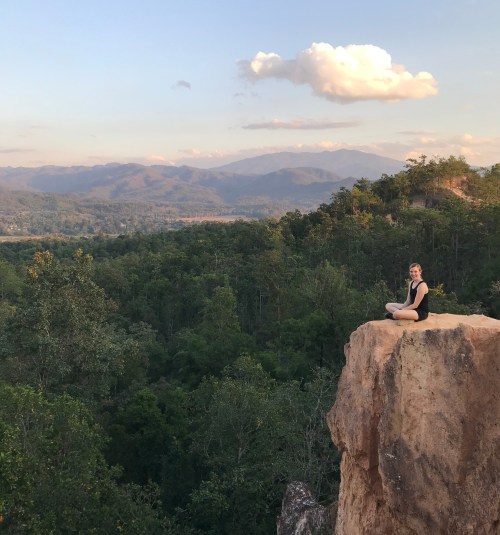
We had intended to ride on to the waterfall and bamboo bridge, but the sun was sinking low in the sky and we wanted to catch sunset at Pai Canyon. We took the little road back to the main paved road where we rode another 5 km to the canyon. We parked our bikes among dozens of others and made the short walk up to the canyon. I had seen pictures of the canyon, but was amazed by its size. The spine of the canyon divided and snaked it’s way back as far as I could see. Although there were dozens of other tourists at the canyon, we were all so spread out along the trail that it didn’t feel crowded. We walked back along the spine until we found the perfect sunset spot. As the sun sank behind the hills, I soaked in the colors of this foreign landscape. What a life.

img_2099.jpg

The next day we met up with Emily again to explore the places we didn’t have time to see the day before. We had the bikes until 2:30pm, so we got an early start to fit in Pam Bok Waterfall and the bamboo bridge. We turned down the same road we’d been on to the Land Split the day before. We didn’t know a thing about the waterfall or the bamboo bridge, but we’d quickly realized that when traveling by motorbike it was less about the destination and more about the ride. And the ride was gorgeous. It was mid-morning and the sun was giving a gentle warmth rather than the afternoon tropical heat. We passed houses on stilts and fields where buffalo grazed.

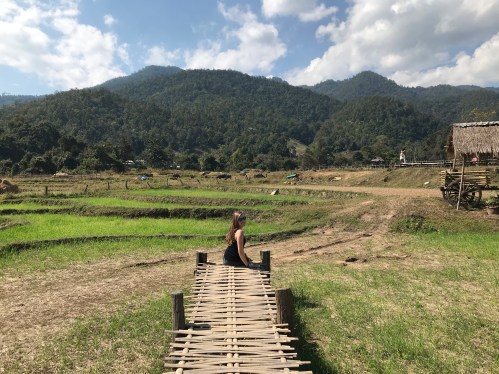
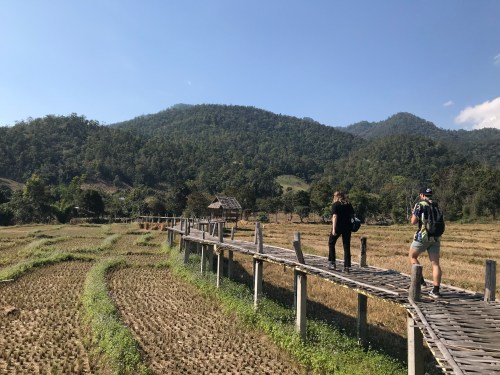
After about 30 minutes we reached the bamboo bridge and paid the small entrance fee. Similar to Pai Canyon, we had no idea what to expect. Similar to Pai Canyon, it was much longer than we realized. We walked along the creaky bridge through the rice fields, dry this time of year, and past farmers working the land. We eventually reached the end of the bridge where we found a wat (temple) in the forest. Classic Thailand.

IMG_2107.jpg

By the time we got off the bamboo bridge and returned to our motorbikes, it was beginning to get hot. We stopped for mango smoothies before continuing on to the waterfall. We parked our bikes in a gravel parking lot and climbed a short series of steps to the base of the falls. Here we found a dozen others perched on rocks, enjoying the falls and eating picnic lunches.

Only a few people were swimming, most finding the water too cold. I dipped in a toe and found it the perfect swimming temperature, no colder than the lakes of the Midwest that I grew up swimming in. I stripped down to a sports bra & underwear and jumped in! I swam beneath the falls then perched on a rock to the side of the falls. After watching a few guys climb the rocks and jump into the base of the falls, I gave it a try myself. The climb to the top of the rocks was a bit sharp & slippery, so once was enough.

e892962f-5b6a-47ea-a318-1075f82ed939.jpg

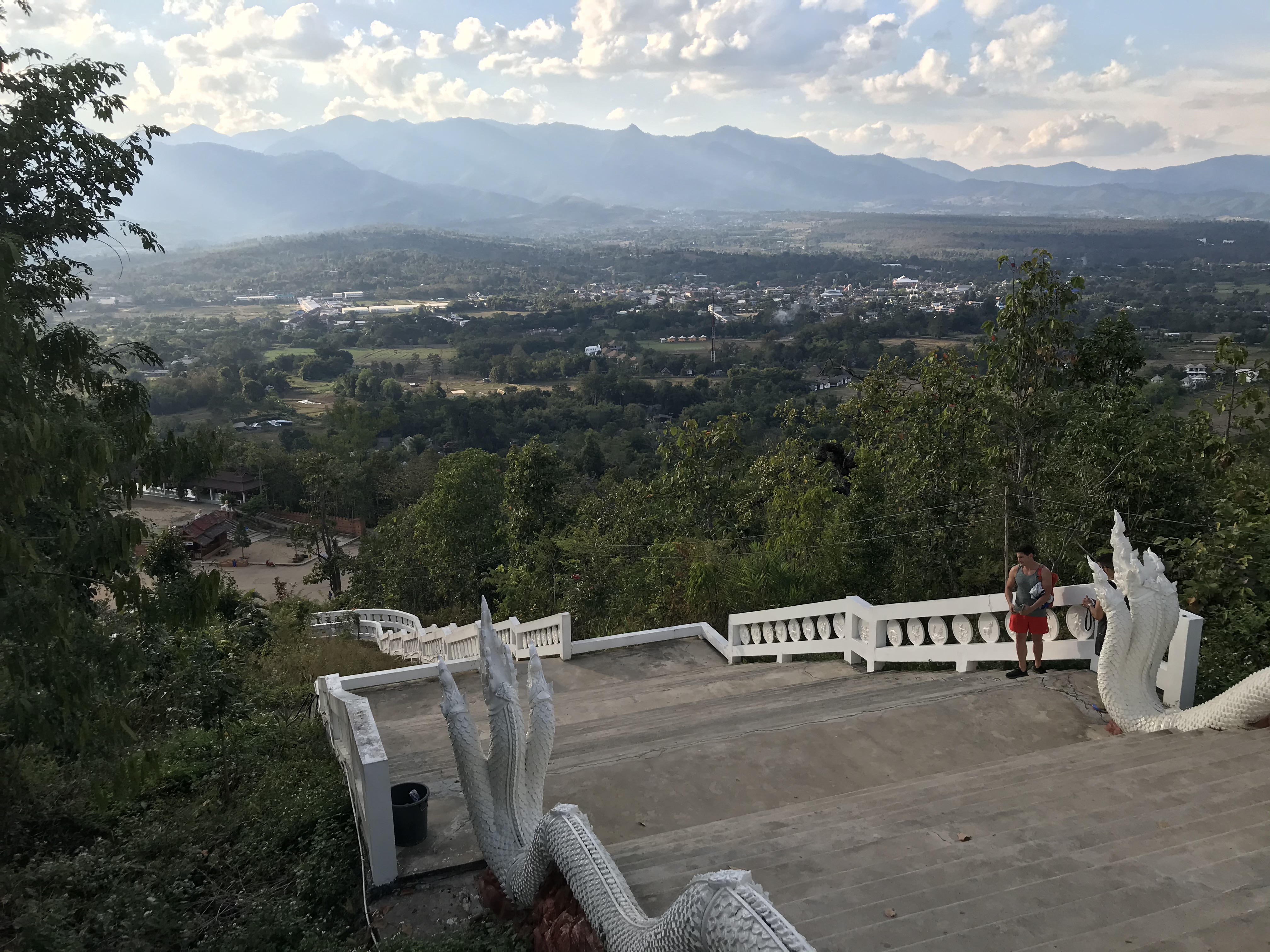
We dried off and mounted our motorbikes one last time to ride back into town. We arrived back at Vespai motorbike rental shop at 2:30pm exactly. We had officially made it 24 hours with a motorbike with no license, no experience, and thankfully, no incidents. Emily returned her bike, while Bastian & I kept our motorbikes for one more day to explore the Big White Buddha (Chedi Phra That Mae Yen) and do the first section of the hike to Mae Yen Waterfall (which we did barefoot).

Our time in Pai was over too quickly, as people warned us it would be. Although the scenery in Pai was amazing, what I liked most about the little backpacker haven was that it so perfectly represented why I love to travel. We met a perfect strangers who become an excellent travel partner, even if just for a day. We took risks hopping on a motorbike, but maintained our wits and saved our heads. We explored, we learned, and we moved on to the next place and the next adventure yet to unfold.

IMG_2260.jpg

P.S. I’m not planning to ride anymore motorbikes in Southeast Asia. You can breathe a sigh of relief Mom & Dad 😉

Bangkok Hustle

I debated beginning my Thailand blog with a story of getting conned. But that is how my trip began, so that is where this story starts.

IMG_1862.jpg

It was Saturday, December 28, 2019. My first full day in Bangkok, Thailand. I would be exploring the city solo for a few days until my friend arrived on New Years Eve. I was excited, but slightly apprehensive about exploring this massive city on my own. Unlike Nepal, I didn’t know the language and knew very little about the country. When people heard I was going to Thailand, they told me to “be careful,” often referencing the infamous Red Light District and sex trafficking industry. Later I would learn that sex trafficking is roughly equivalent to shootings in the US. Under-reported when it happens to minorities, over-reported when it’s the upper class. Any incidents are too many. It’s atrocious. Yet the risk doesn’t stop us from leaving our houses each day.

However, at the time, I knew virtually nothing about Bangkok aside from what I’d heard and the small amount of Googling I’d done to prepare for my trip to Thailand. On the day I arrived, I learned to navigate the train and the metro from the airport to my hostel, Warm Window Silom, in a quiet business district. Since that’s what I knew, that’s how I started on my first full day in Bangkok. I walked to Lumphini Park and hopped the train to city center. From there I found Chao Phraya, the major river that drains the Northern highlands, runs past Bangkok, and empties into the Gulf of Thailand. I figured if I stayed along the river, I could explore without getting terribly lost.

IMG_1864.jpg

As I walked, I observed my new surroundings. Shop owners sold clothing, jewelry, and cheap plastic products in bins. The smell of fried chicken and pork wafted from restaurants preparing classic dishes with names like tom yum goon, laap, phat kaphrao, and khao soi. Later on these names will become familiar, but right now there are meaningless, mixing with all the other unknown languages being exchanged around me. And then there was the street food. All sorts of fruit eaten with wooden skewers, unidentified meats of being cooked over coals, thin crepes called roti often filled with banana drizzled with syrup (a tourist favorite)… all for less than $2.

I grabbed a couple sliced mangoes from a fruit stand and left the river veering towards the tourist district. Specifically, Khao San Road. Khao San is known by tourists and Thai alike for being a raucous party district for backpackers traveling Asia. I was planning to steer clear of Khao San after sundown, but wanted to say I’d been there and earn my Thai tourist badge.

IMG_1907.jpg

I was a few blocks from Khao San when I was stopped by a small middle aged Thai woman. She told me she was practicing her English. We chatted about upcoming holiday and she taught me the phrase Sawadee Pee Mai, Happy New Year! She asked where I was going. I told her towards Khao San Road and possibly the Chatuchak Weekend Market. She asked if I was new to Thailand. I was. She asked if I was traveling alone. I was. This should have been a red flag for a scam, but the woman seemed so innocent that the thought didn’t even cross my mind. That is, until she gave me a paper with a written price for a long tail boat tour and hailed a tuk tuk to take me to the “Thai dock” where I would find a dozen white tourists like myself about to embark on a $70 boat ride. This was a hustle. She was good. I was an idiot.

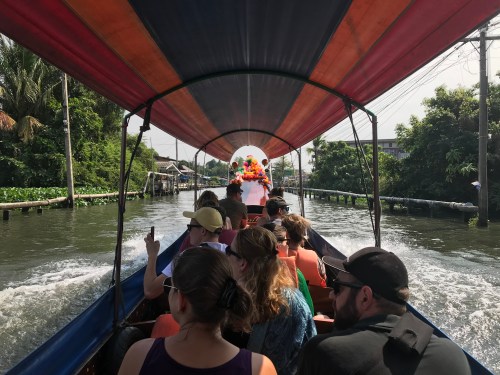
I was ushered to the back of a colorful long tail boat where I would sit brooding for the first 20 minutes of the boat ride. After I got over myself, I began to look around and take in the scenery. I payed way too much for this boat ride to not enjoy it! I wasn’t really sure where we were going, but I overheard the other tourists talking about a floating market down one of the channels and looping back past Wat Arun temple. It sounded sort of fun, I guess. So I settled in for the first of many unexpected adventures.

IMG_1859.jpg

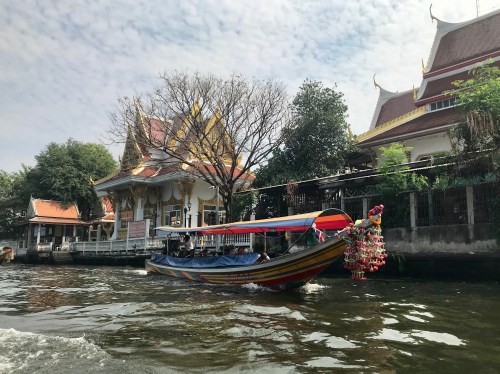
We quickly left the busy Chao Phraya River with it’s barges and cruise boats and entered the quiet channels lined with ramshackle houses on stilts, tropical gardens, and small temples with classic Thai architecture. After about half an hour the boat pulled up to a dock and dropped us off. The driver told us 30 minutes and set us loose. We were at Taling Chan, part floating market, part street market.

I wandered around the street market looking at all the interesting foods. One thing I didn’t anticipate was how much meat & fish was in the Thai diet. Back home I’m vegetarian, however when I travel, I make exceptions. For this trip, I’ll have to be more of a pescatarian. Eating more shrimp and tilapia is sacrifice I’m willing to take.

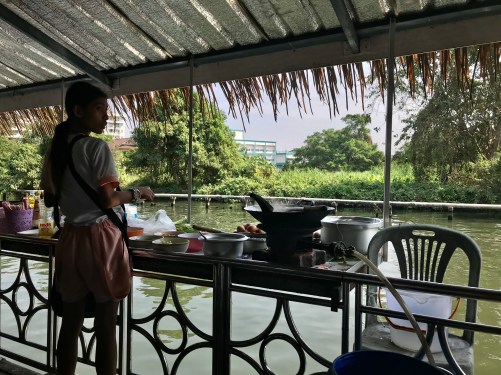
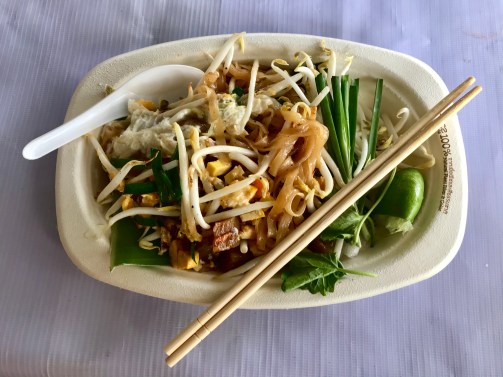
I picked up a little bowl of pineapple sticky rice and sampled a fried pastry from one of the street stands. I then ventured into the floating market section for my first pad thai, complete with prawns, tofu, and spices that made my mouth water. All for $1.50. I could get used to this.

IMG_1861.jpg

Soon our 30 minutes were up. I hurried back to the dock so as not to miss my expensive boat ride back to Bangkok. We spent nearly an hour working our way through the canals, passing more houses on stilts, temples, and other colorful long tail boats filled with wide-eyed tourists like myself. I wondered how many of them intended to take a boat tour today.

IMG_1961.jpg

We emerged back onto the main river by Wat Arun, arguably the most iconic Buddhist temples in Thailand. We crossed the river back to the Bangkok side and stopped at various docks to unload passengers. We did not stop at the “Thai dock” that I’d been thrown on at, so I just hopped off at the last dock. I couldn’t help but laugh at the events of the past few hours: tricked into a tuk tuk ride to a tourist dock where I was taken by boat through a maze of channels and eventually dropped off again at a random dock. Worth the $70 for the 3 hours of boat travel? Definitely not in Thailand. Worth a good story? Absolutely.

There’s a Whole World Right Here

Reflections on 2019

IMG_0344.JPG

I am in my last year of grad school in La Crosse, a city I’ve come to know & love over the past seven years. It will be sad to leave this river town with its hiking trails, bike paths, and active community that I’ve grown a part of throughout college. Although leaving a place is difficult, getting the opportunity to explore someplace new makes it worthwhile! Next summer I’ll be heading to the East Coast for my first physical therapy clinical rotation at the Coast Guard Academy in New London, CT. My second rotation will be spent in Beloit, WI working with a Birth to 3 Program. I don’t have my last hospital clinical assignment yet, but I’m hoping to make it out to explore the Western states for Spring of 2021.

IMG_1743.JPG

Of course, I don’t need to wait for clinical to explore. In the past year I’ve had plenty of opportunity to explore many states on foot! My 2019 backpacking adventures included the Santa Rita Mountains in AZ, Gila National Forest of NM, Chippewa Moraine in WI, Isle Royale National Park in MI, and most recently, the Ouachita Mountains of AR. I’m always reminded on my backpacking trips how much beauty we have just beyond our back yards!

However, the itch to travel overseas remains. I haven’t been out of the country since Nepal, so when I discovered that we have a 5 week vacation in December/January, I knew it was time to escape to another country. So last month I bought a plane ticket to Thailand, eager to explore more of Asia. I fly out on Christmas day and return a month later. No solid plan, just a wild desire to see and experience the unknown. Travel light & go far!

img_1452.jpg

Leaving Home to Return Home

Reflections on 2018

unnamed-1-1.jpg unnamed (2).jpg unnamed (3).jpg

My life has come full circle this past year and a half. I went from being a student at University of Wisconsin – La Crosse to living in Nepal for eight months to being a student again. I’m now back at UWL, but this time as a graduate student. It was difficult leaving a life of constant travel; the simplicity and constant change; the fresh perspectives and connection. However, I felt I should finish the journey I started five years ago during undergrad and become a physical therapist. 

Graduate school in the U.S. is a different world than backpacking through Nepal. It’s hard to summarize my time in Nepal. I spent weeks backpacking in the Himalayas, worshiped beside Tibetan monks, navigated the dusty streets of Kathmandu, learned to barter in the market, danced in rice fields, and shared more cups of tea than I could count. I have never been so engaged, challenged, and open in my life. It was beyond my wildest dreams.

When I returned to the U.S. in May, it was like someone pressed fast-forward. I visited friends & family on the East Coast. Took a road trip out to the Badlands & Mount Rushmore. Registered for classes and begin preparing for the next adventure: graduate school. Spending the summer in PT school in Wisconsin was a bit underwhelming after a year of travel, but I managed to have a little fun between long hours of study. 

I hoped that a year abroad would quench my thirst for travel over the next three years of grad school. It did not. If anything, it only made my desire to travel stronger. I often catch myself daydreaming about my next escape: Winter break backpacking in Arizona. Maybe slipping in a trip to Isle Royal next summer. Perhaps South America in 2020.  And, of course, Nepal. 

There’s a quote by Mark Twain that goes like this:

“Twenty years from now, you will be more disappointed by the things you didn’t do than by the ones you did do. So throw off the bowlines. Sail away from the safe harbor. Catch the trade winds in your sails.”

I’ve thought about these words often during the past year. Although I love this quote, I believe what it asks can’t be done. By doing one thing, you will always be missing out on another. By going to grad school, I may be missing out on opportunities abroad. But by remaining abroad, I would miss the boat to becoming a physical therapist which opens channels to seas I never knew existed. I realize that I don’t have time in this life explore every sea. No one does. All we can do is continue to sail and expand our maps.

unnamed.jpg unnamed (4).jpg unnamed (5).jpg

Three Goats & a Kid

IMG_1313.JPG

I stood in a stuffy waiting area outside of Tribhuvan International Airport, craning my neck to catch the first glimpse of the three travelers whose plane had touched down in Kathmandu just 30 minutes ago. I’d been at the airport for nearly an hour, pacing the floor, trying to contain my excitement. It was April 14th and I had been in Nepal for almost exactly seven months. I’d been keeping in touch with family and friends over email and the occasional phone call, but today, I would see some of them in person. This was my first step in returning home. 

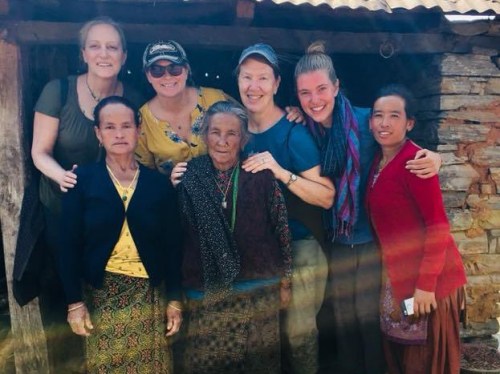
For the past four months I’d been keeping an ongoing thread of emails between my mom and two of our trusty travel buddies, Jenny & Mary. My mom had decided early on in my journey that she would join me for my last couple weeks in Nepal. Mary & Jenny were the perfect additions to the group. We’ve traveled with them around Uganda & Turkey and knew they weren’t afraid to go off the beaten path. Excited to show the trio all the things that made me fall in love with Nepal, I planned an ambitious itinerary – trying to pack my seven months of travel into 17 days. I created a list of places & dates, contracted a driver, set up hotels, and reached out to all of my host families. This would be the finale to my time in Nepal. And I would get to complete my journey with the people who inspired and supported me before it even begin.

IMG_1364.JPG

Finally, I saw them. I waved my arms wildly and smiled widely. They walked slowly, suitcases in hand, eyes scanning the crowd of dark faces and jet black hair until… they saw me. Despite the fact they had been traveling for over 24 hours and were experiencing some serious jet lag, their eyes lit up and they waved back. I wanted to jump over the barrier, past security, and give them the biggest hugs of my life. But I followed the rules and waited until we met outside the airport to give each of them the hugs I had been saving for seven months. Together at last.

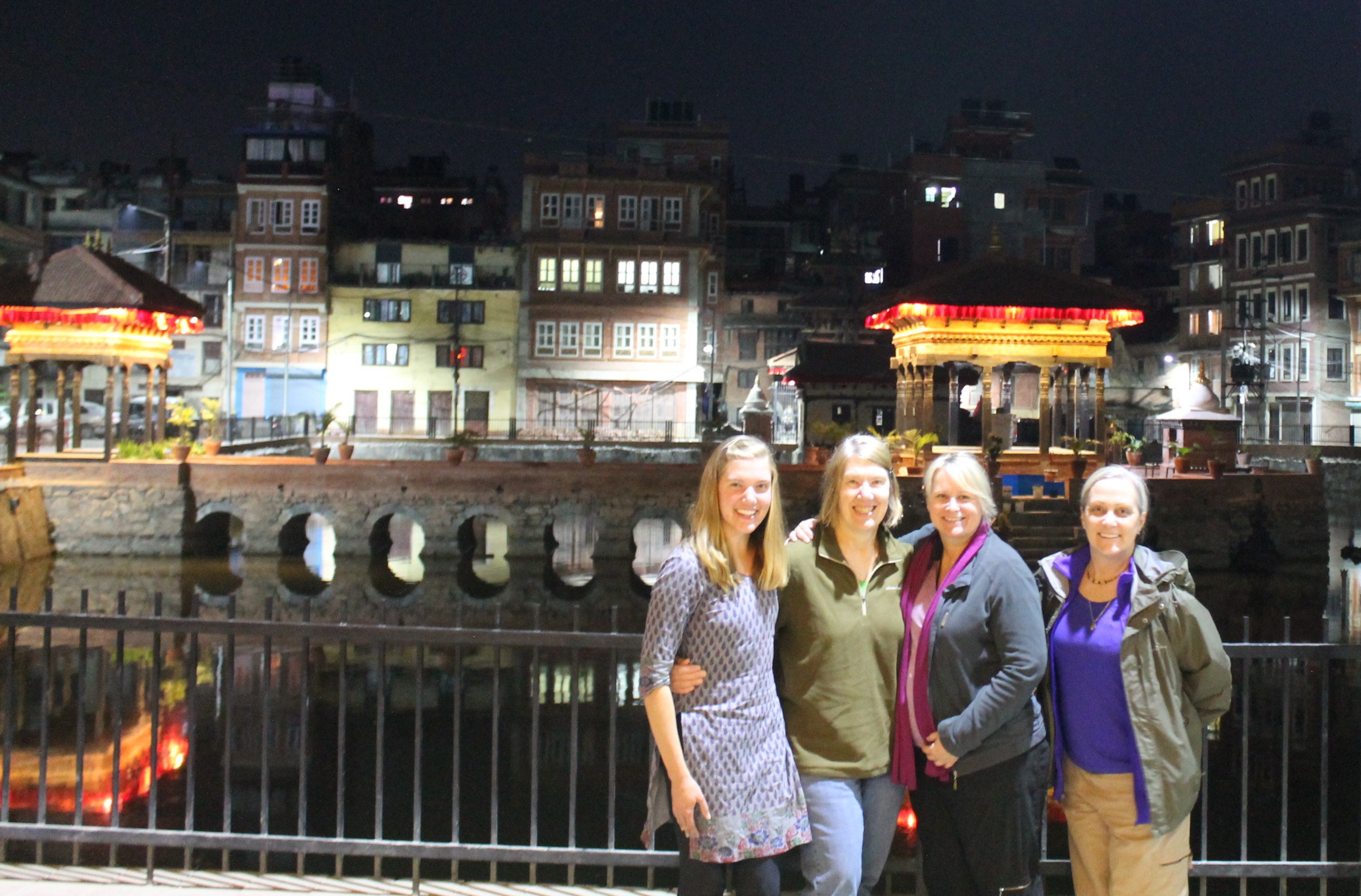
After much excited chatter and a few happy tears, we loaded up the hired van that would take us to our lodge in Patan, Tajaa Pha Heritage Home. I had briefly met the gregarious owner, Shailendra, during my time with the Dragons program and sensed he would be an excellent host if I ever stayed in Patan. The quiet Newar community of Patan had always been one of my favorite areas of Kathmandu, a nice escape from all the dust, noise, and hustle of the big city. I’d been reluctant to book it as it was very expensive, $50 per night for a gorgeous room with running water and a view out onto a historic pond and stupa. After living in Nepal for 7 months and never paying more than $15 for a room, the price seemed steep. However, when I told my travel companions the price, they reminded me that was a bargain by US standards!

IMG_1216

It was dark when we arrived at Tajaa Pha, so my travelers didn’t get to see the beauty of Patan until sunrise. We ate breakfast prepared by Shailendra’s wife & daughters on the rooftop overlooking 600-year-old Pimbahal Pokhari pond. Throughout the neighborhood we heard the chimes and chants of morning prayer. I was glad that I’d chosen this place to introduce Nepal. Many travelers who land in Kathmandu hate the city, but I will always maintain that they just aren’t going to the right places. Patan is definitely the right place.

The first day I’d reserved for acclimation, both to the culture and the time zone (12 hours & 15 minutes ahead of Wisconsin). We walked the cobblestone streets of Patan and wandered into various shops lining tight alleys. I’m not very helpful to Nepal’s economy when it comes to buying souvenirs, but my mom, Jenny, & Mary made up for what I lacked. Scarves, singing bowls, scarves, tea, scarves, spices… Oh, and did I mention scarves? They were every shop owner’s dream customers! I reminded them that this was just the beginning and there would be plenty more shopping opportunities to be had over the next two and a half weeks.

IMG_1230.JPG

Before leaving Kathmandu and heading North to the Himalayas, we had an important order of business: my mom, Jenny, & Mary needed to meet the Basnets, the big, loving Kathmandu family that hosted me over a month during my time with Dragon’s. They had insisted that we stay with them during our time in Kathmandu, but I politely declined, knowing that living in a small Nepali apartment with 11 others would be a bit too much culture shock for my travelers. Instead we agreed on dinner, a Nepali dinner at the beginning of our trip and an American dinner at the end.

As fate would have it, my ama and my mom met each other on the Nepali Mother’s Day! Although neither spoke the other’s language, the connection was instant. While my ama & didi’s were hard at work in the kitchen preparing what would be the first dal bhat for my travelers, I introduced the rest of the family: Avishik, Arvin, Akriti, Aditi, Aroshi… Too many names to remember, but what they would all remember was their warmth and outgoing personalities. As well as their love of card games & winning at all costs, even if the methods were less than honest. Arvin explained, “cheating is a kind of talent.” Not wrong.

img_1226-e1577672595373.jpg

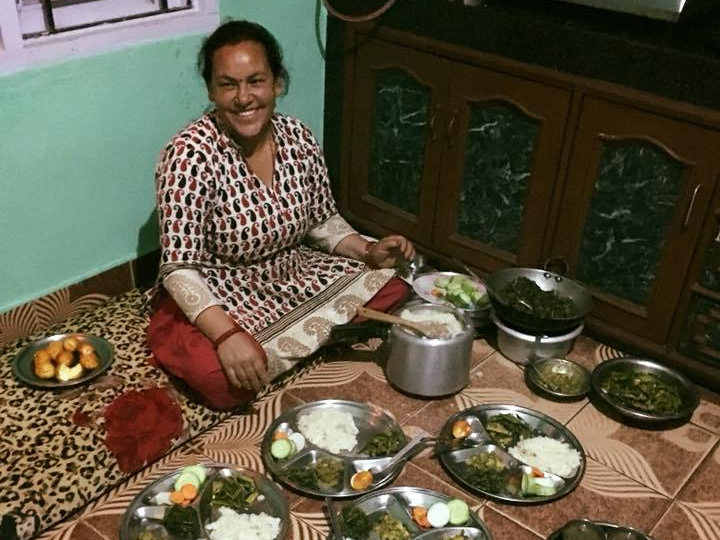
Being guests of honor, we were served right after Hari, the grandfather and patron of the house. We ate dal bhat in traditional Neapli style: sitting cross-legged on the floor using our hands to shovel down the rice, lentils, vegetables, and an egg (a special treat!). Watching my mom, Jenny, & Mary experience this new way of dining was comical and had everyone roaring with laughter. I imagine it was similar to my first genuine Nepali dining experience!

30727237_2060785003933723_2004260580466098176_n.jpg

With bellies full of bhat and sore from laughing, we hopped a taxi back to Patan. We had to rest up for our 10 hour van ride North the next day, towards Balamchaur and another wonderful host family that I would have to say goodbye to.

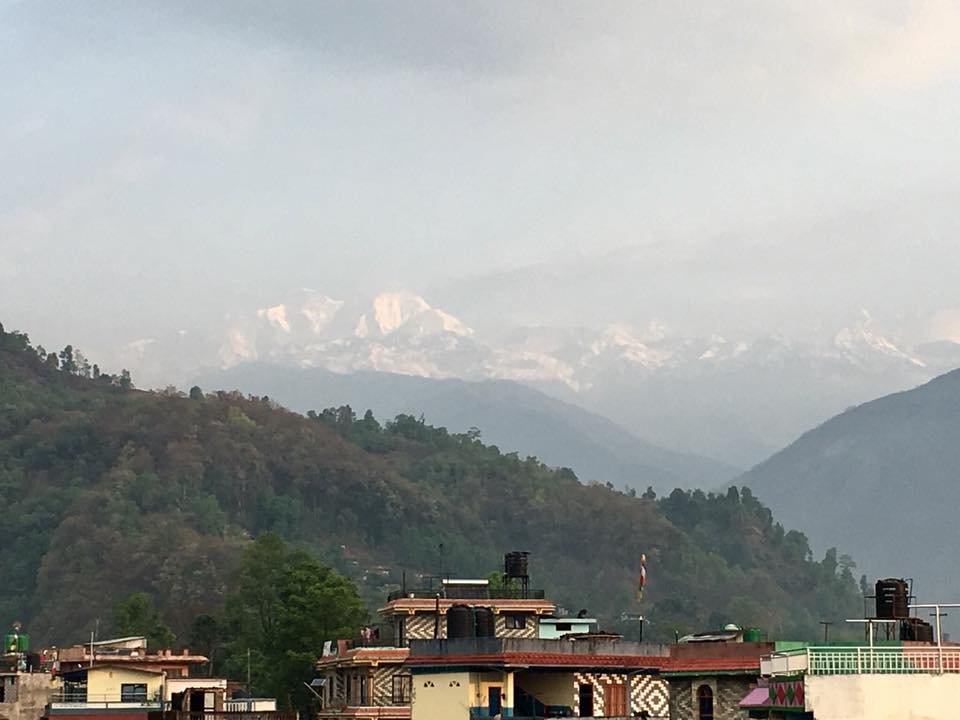
The next night was spent in Besisahar, the same city where I started my Annapurna Circuit Trek just over a month ago. Everyone was in awe of their first views of the Himalayas… until I told them they were just looking at the dadas (foothills)! In the morning they awoke to the actual Himalayas towering beyond the hills, snow capped and awe inspiring.

30715719_2062072177138339_2175873102653685760_n.jpg

After breakfast, we met Becca, the Peace Corps volunteer serving this area that I’d befriended during my time with Dragon’s. Without her, returning to Balamchar would have been difficult and probably would not have happened. With Becca as our trusted guide, we began our hike up to Balamchaur, the Gurung village set against a stunning backdrop of the Himalayas. Here we would stay with my didi, Ritu, and ama, Manu. We stopped halfway up the hill for tea with a local woman, a classic Nepali gesture of kindness. After an hour or more of hiking, some decided to take advantage of the local shuttle truck on its way up the hill. I kept hiking, loving the familiarity of the path that I’d taken several times throughout the past seven months. I wondered it this would be the last time.

As I entered the Balamchaur, I was greeted by villagers calling out “Laksmi!” the Nepali name I used when “Laura” was too hard to remember or pronounce. I smiled and gave a “Sanchai Chha?” (How are you?) in return. Finally there was Ritu and Manu. I bowed my head to Manu and gave Ritu a big hug. It truly felt like returning home.

31059674_2066230186722538_4243540998275203072_n.jpg

The next few days were spent introducing my mom & friends to the village and all its people. They watched Ritu work her magic on the loom, tried Manu’s strong rakshi, and talked with Becca about agriculture in Nepal. We spent one night up at Ghale Gaun, a well known Gurung heritage site, a few miles up from Balamchaur. Straight UP. The slogan of that trek became, “What’s up…? NEPAL!” However, everyone agreed the breathtaking views of the Himalayas at the top was worth the hours of hiking in the heat. This place is sacred to the Gurung people. Looking out over the misty valley below and the mountains towering above, we understood why.

IMG_1289.JPG

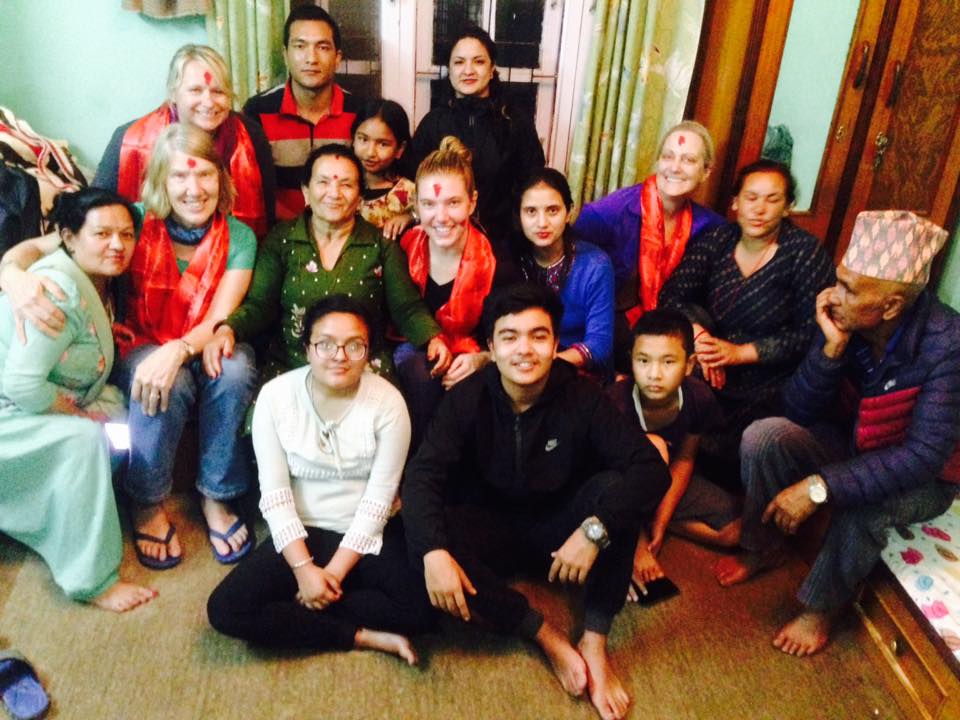
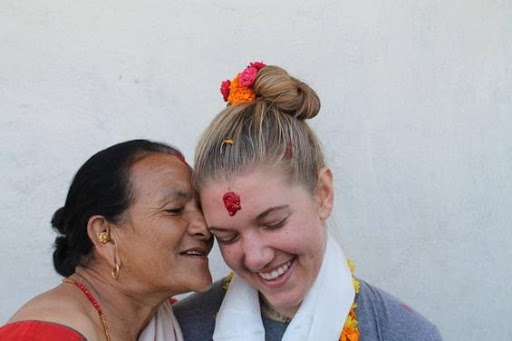
All too soon, our time in Balamchaur was over and the white truck was pulling up to take us back down the hill to Besisahar where we would catch a bus to Pokhara. Before leaving, Ritu and Manu gave us the traditional Nepali goodbye by placing tikka on our foreheads and draping prayer scarves around our necks. We gave gifts, but could not repay the hospitality and love we’d been shown by these people from the other side of the world. I quickly knelt to touch Manu’s feet, the ultimate sign of respect, before she had the chance to stop me. She clicked her tongue at me and smiled. I gave Ritu one last big hug. I told them that we would meet again. I wondered if that was true.

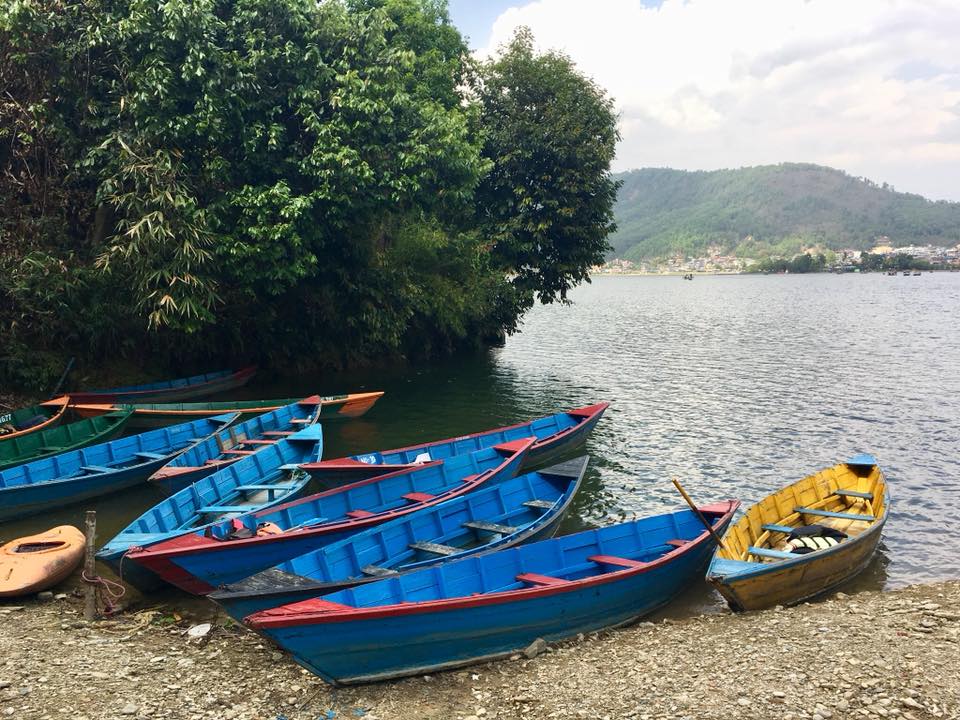
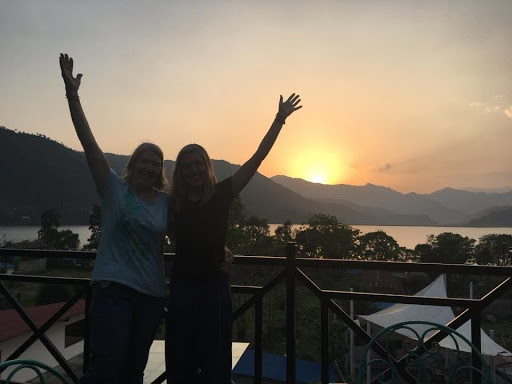
Pokhara was a 180 degree flip from the remote mountain village of Balamchaur. We stayed in a beautiful hotel with private rooms, hot running water, a balcony, and a lovely courtyard. It was $22 a night. A little above my price range, but what the heck, it’s vacation! The hotel was just a short walk from Phewa Lake where we hired a boat to take us over to the trail leading up to the Peace Pagoda. From the top we had an unusually clear view of the Himalayas and the iconic Machhapuchhre (Fishtail Mountain). On our way back across the lake, we convinced the boat driver to drop us off at Crazy Gekko, the best treehouse hangout along the lake. We ended the day with a lake view sunset dinner at my favorite Mediterranean restaurant in Nepal, OR2K. After rugged village life, we felt pretty posh in Pokhara!

31144179_2068029439875946_1057034027556405248_n.jpg

From Pokhara we hopped a plane to Chitwan to visit the last of my thee host families, the Adhikari’s. The journey that took me a whole day by bus took us about 30 minutes by plane. It’s nice to travel with people who have money!

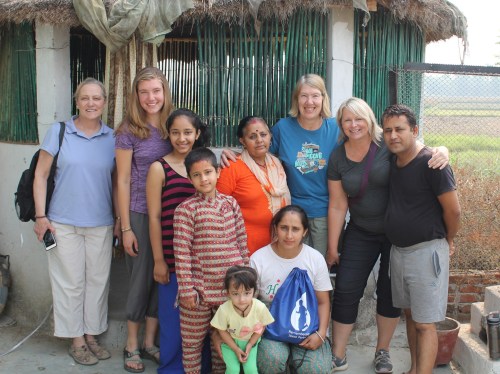
We were met at the airport by Babu, my host mom’s brother who owns a car (a luxury only high class Nepali can afford). He drove us to the village of Sukranagar where I was greeted by Tara, Anjana, and their children, Akriti & Anunta. Anjana was especially excited to meet my mom & friends. They bonded immediately. It was no surprise; who wouldn’t love Anjana?

img_1354.jpg

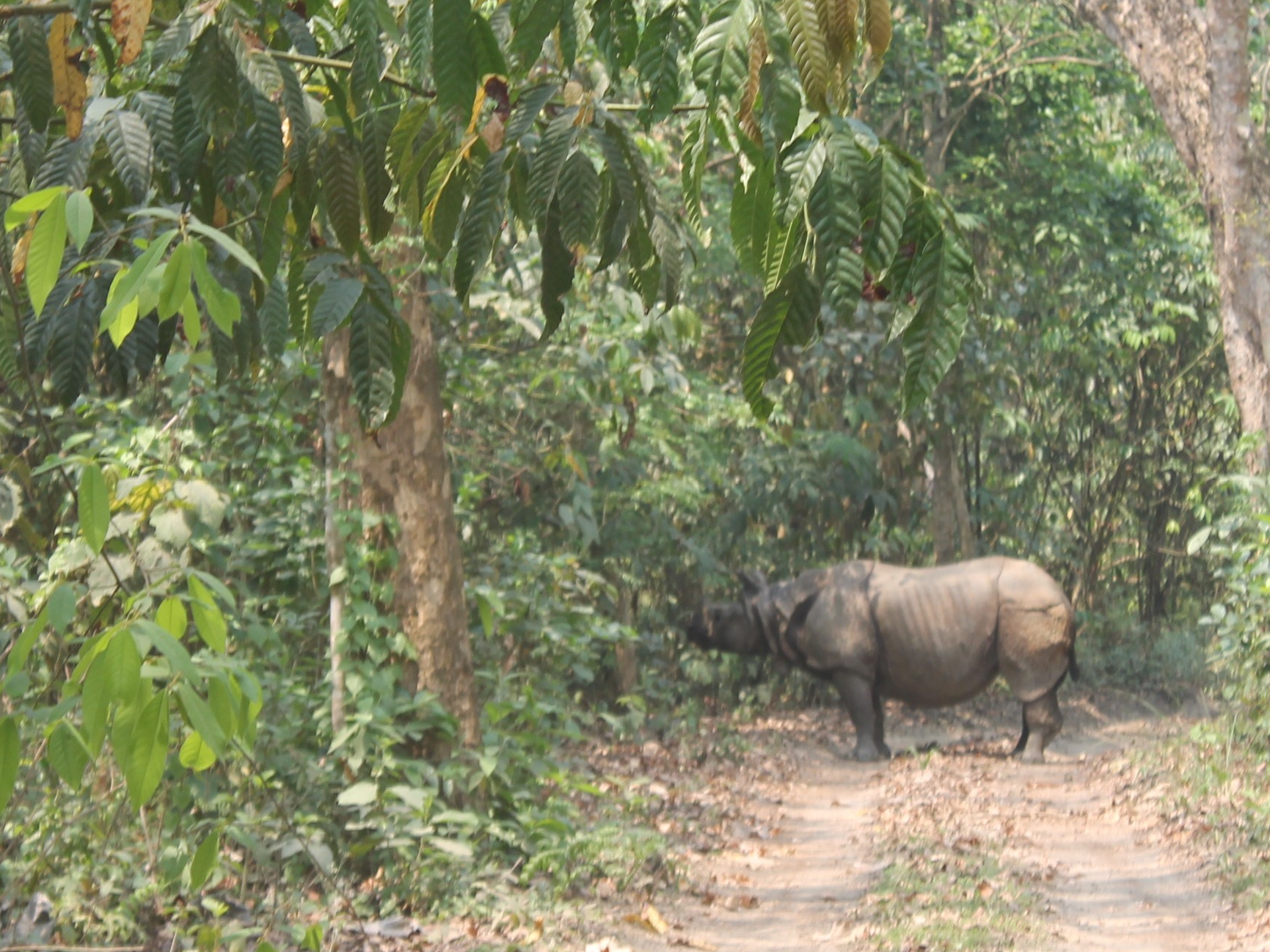
We only had a few days, but made the most of our time. We went on a jeep safari in Chitwan National Park where we saw elephants, wild boar, sloth bear, and numerous rhino. We startled one particular rhino who later sought revenge by charging after our jeep. We had just narrowly outraced the rhino when our driver stopped and put the jeep in reverse. We all asked him what on earth he was doing. He simply said, “You want to see rhino?” We told him we’d seen quite enough of the rhino. It was a little too close of a wildlife encounter for our taste.

img_1323.jpg

Back from the safari, we strolled around the Sukranagar, stopping by Anjana’s little shop and childhood home. That night we celebrated Ananta’s 10th (or 9th) birthday. In Nepal you are 1 when you are born as it is your first year of life. So when you travel to Nepal you are considered a year older than what your actual age is by Western standards. Traditionally, birthdays are not a big ordeal in Nepal. Most older Nepali don’t even know when their birthday is! However, Western culture is creeping into Nepal and most young Nepali celebrate birthdays with cake and presents. And dance. Because no celebration in Nepal is complete without dancing!

That night I also said goodbye to the neighbors who I had passed by nearly every day for two months while living with the Adhikari’s. I gave them sweets from the US and received gifts of gundruk (dried fermented lettuce) from the neighbors next door and a hand sewn kurta from the sweet little seamstress that lives by Tara’s school. I hadn’t realized how many people I actually knew in the village until I returned. For the third time, I felt like I was back home.

IMG_0814.JPG

Not for the first or last time during the trip, we hugged our gracious hosts and said goodbyes before heading to the airport to catch a flight back to Kathmandu. 

Back in the city, our trip was nearing the end, but it was not over yet. My mom, Jenny, & Mary had gotten a genuine Nepali experience during the homestays, but they had yet to see the attractions in and around Kathmandu. After a night of restoration at Tajaa Pha, we loaded into our personal van and headed just outside the city to Thrangu Tashi Yangtse Monastery. This was the only monastery I stayed at during my time in Nepal, but the experience was incredible and I was eager to go back. It did not disappoint. We dined on chana, Tibetan momos, and butter tea amongst a sea of orange robes worn by monks young and old. We walked up stone paths lined with prayer flags to get a glimpse of the surrounding hills with villages tucked in between. We attended worship and prayed as the monks chanted their mantras and beat steadily on drums. Just like the first time, it was magic.

31674348_2075876045757952_7230420251307933696_o.jpg

Our return to Kathmandu was a bit cumbersome. It had rained the days we were at the monastery, reducing the road to a giant orange mud slide. To make things more interesting, a traveler who we had offered a ride back turned out to be rather high maintenance. She was not accustomed to traveling through mud on foot and had quite a bit of luggage with her, including a large suitcase of philosophy books. To make a long story short, we have plenty of good karma saved up from that memorable trip back to Kathmandu.

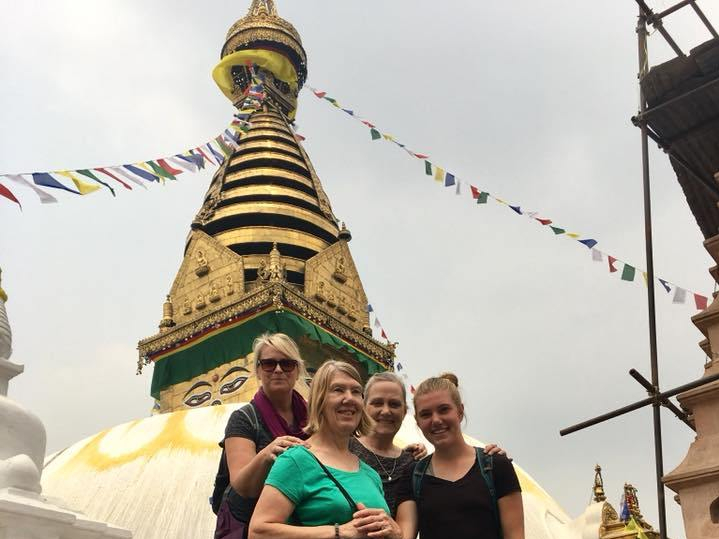
We finished the trip in Nepal how most travelers start: seeing the Buddhist Temples. We hiked up to to Swayambhunath Stupa (called Monkey Temple by tourists) and had tea overlooking the hazy Kathmandu Valley. In the late afternoon we made our way over to Boudhanath Stupa where my mom, Jenny, & Mary could satisfy their shopping needs. We found a rooftop restaurant as the sun was setting and watched the stupa light up as darkness fell. I’d never seen Boudhanath at night before. It was striking.

31378719_2072623689416521_2047569291217207296_n.jpg

As promised, we returned to visit the Basnet family to prepare and serve them a classic American dinner. This consisted of cucumbers with tuna salad, toasted almonds, mac-n-cheese, salad with ranch dressing, and olives (not loved by all). For dessert we had brownie pancakes topped with peanut butter. Okay, so it wasn’t your classic American dinner, but it was certainly a cultural experience! After dinner we were given the traditional Nepali send off with tikka, prayer scarves, and small gifts. This was the final goodbye to my last host family. Soon I would be saying goodbye to Nepal.

31492724_2072474959663819_7068885247110152192_n.jpg

The last day I turned my travelers loose to buy any remaining items they had on their list along with more scarves. I took the day to meet up with a friend I’d met while backpacking the Annapurna Circuit. By coincidence, we were both flying out May 1st, and therefore were both staying in Kathmandu. We finished off souvenir lists of our own and grabbed pizza & tiramisu in the backpacker district of Thamel. We talked about past, present, and future travels. We both agreed that we would return to Nepal to trek around the Himalayas. Someday.

On the taxi ride back to Patan I held back tears while the driver chatted away in Nepali. This was it. My last night in Nepal. The next day I would board a plane a watch the country disappear beneath a blanket of clouds. Nepal had been home for 8 months. It had become familiar, comfortable, even normal. That is how I knew it was time to go. I was flying back towards the US and back into the unknown: grad school. I thought this year away might change my mind, but it hadn’t. I would go to school for physical therapy. I would get my doctorate. Because the opportunity is there. Because it is a privilege. Because I have the potential. Would physical therapy become my be-all and end-all? I don’t know. But there are two things I know for sure: (1) Wherever I end up and whatever I end up doing, I will always be a traveler. (2) Someday, I will find my way back to Nepal.

IMG_1346.JPG

Pheri Bhetaula  —  Until we meet again 

Around Annapurna

DCIM100GOPROGOPR1674.

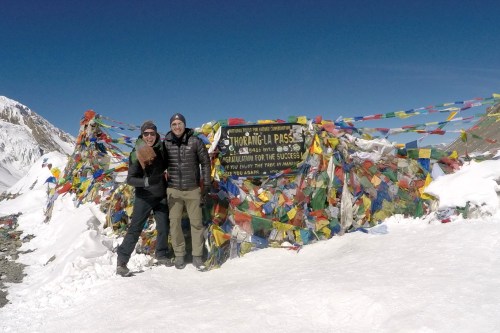
Exploring Muktinath just after crossing Thorung La Pass at 5416 m (around 17,700 ft.)

How do I even begin to describe the past month on the Annapurna Circuit? I could talk about waking up to snow-capped mountains outside a frosty window pane. Or how the weight of my backpack seemed to get lighter as I settled into the rhythm of the trail. I could describe the nights I spent in the lodges huddled around the wood-fire stoves swapping stories with fellow trekkers. Or how some of these strangers would become good travel partners and friends.

I started out on the Annapurna Circuit as a solo trekker, but one thing that I’ve learned from traveling is that you are never truly alone. As soon as I got on the bus to take me to the trail-head in Besisahar, I had a friend. She was an energetic, fast-talking young woman from Brazil named Maura. By the end of the 4-hour bus ride I had a trekking partner and a new friend.

28575718_1716905925026953_4712510886360105867_n.jpg

Maura & Laura: fresh off the bus and ready to hit the trail

Our group grew in the next couple days. We were joined by a couple college grads from the US, a group of friends from Germany, and another solo traveler from Bavaria named Bastian. By the second day, we had a group of nine which we would travel with for the rest of the circuit. That was the plan. However, the thing about trekking (and life in general) is that few things go according to plan.

By the third day, two guys from the group who were feeling sick took a jeep up the trail to wait for us and recover. On the fifth day, I hung back in the village of Temang with Bastian for a much needed rest day. The remainder of the group pushed on. They were on a schedule and had to finish the circuit in time to catch buses and flights out of Nepal.

GOPR1613.JPG

Waking up to fresh snow on the mountains around Temang

Another lesson I’ve learned from travel: don’t put yourself in a time crunch. This would end up being the downfall of nearly half of our trekking group. I had over a month to complete the trail. If I liked a village on the trail, I stopped and explored. If the weather looked uninviting, I waited it out. If I felt a cold coming on, I took it easy for a few days. Most of my fellow trekkers didn’t have that luxury. They had a schedule to follow and needed to push on. That meant passing by incredible viewpoints, walking through rain, and not allowing their body essential time to recover.

So the band broke apart. The two that took the jeep ahead would end up leaving the trail early with another two that got sick before Thorung La Pass (the max elevation at 5416 m). Maura took a side trip to Tilicho Lake before going on to the pass. The last two skipped Tilicho Lake and cut the circuit short just over the pass. After the first week we were only two: me and Bastian.

GOPR1664.JPG

At Thorung La Pass, one of the highest passes in the world!

It was sad to see them go, but after the group broke apart everything slowed down. We cut long days in half and spent time in little towns barely even mentioned in the guidebook. We got to know the lodge owners and I spent time working on my Nepali language skills. At one lodge we even got to help cook the dal bhat! This was exactly the kind of experience I was looking for. I’ve been on hikes where I’ve had to crank out the miles and the challenge was exhilarating. However, this is likely the only time I will be hiking in the Annapurnas. I wanted it to last.

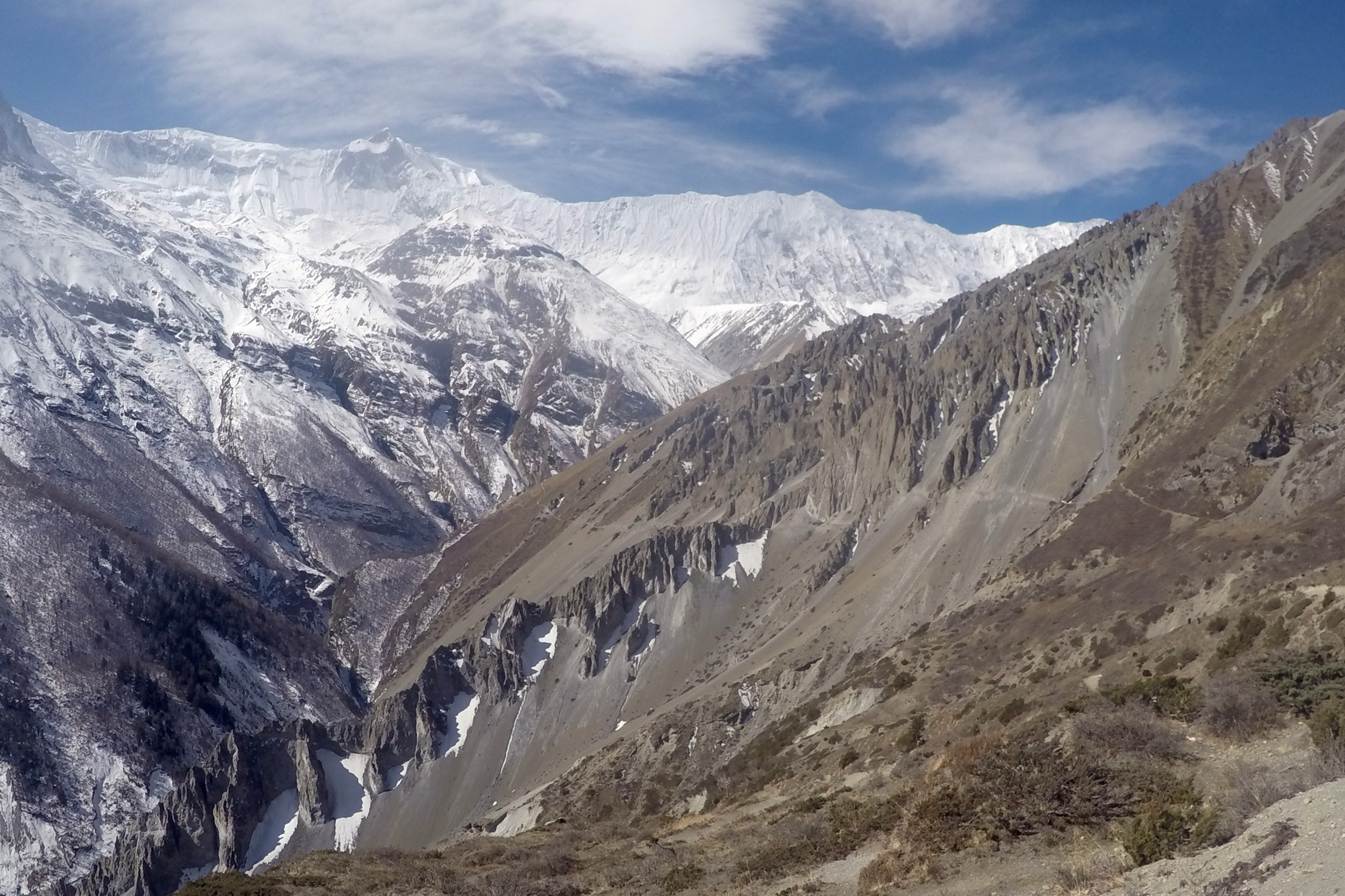
The trip around the Annapurna Circuit took us through all types of terrain. In the beginning we hiked along a coursing river through lush, green forests. Soon we entered the foothills and caught our first views of the snowy mountains. A week into the trek, we were above the tree line, and the land rippled like brown canvas. Up on Thorung La Pass we were surrounded by mountains on all sides without any indication of civilization besides the trail under our feet. On the other side of the pass was desert that reminded me of Arizona. As we descended, a river valley opened up, and trees begin to grow again. I passed through entire seasons over the course of a day. It was unbelievable.

DCIM100GOPROGOPR1639.

The desert brush and snow-capped peaks on the way to Tilicho Lake

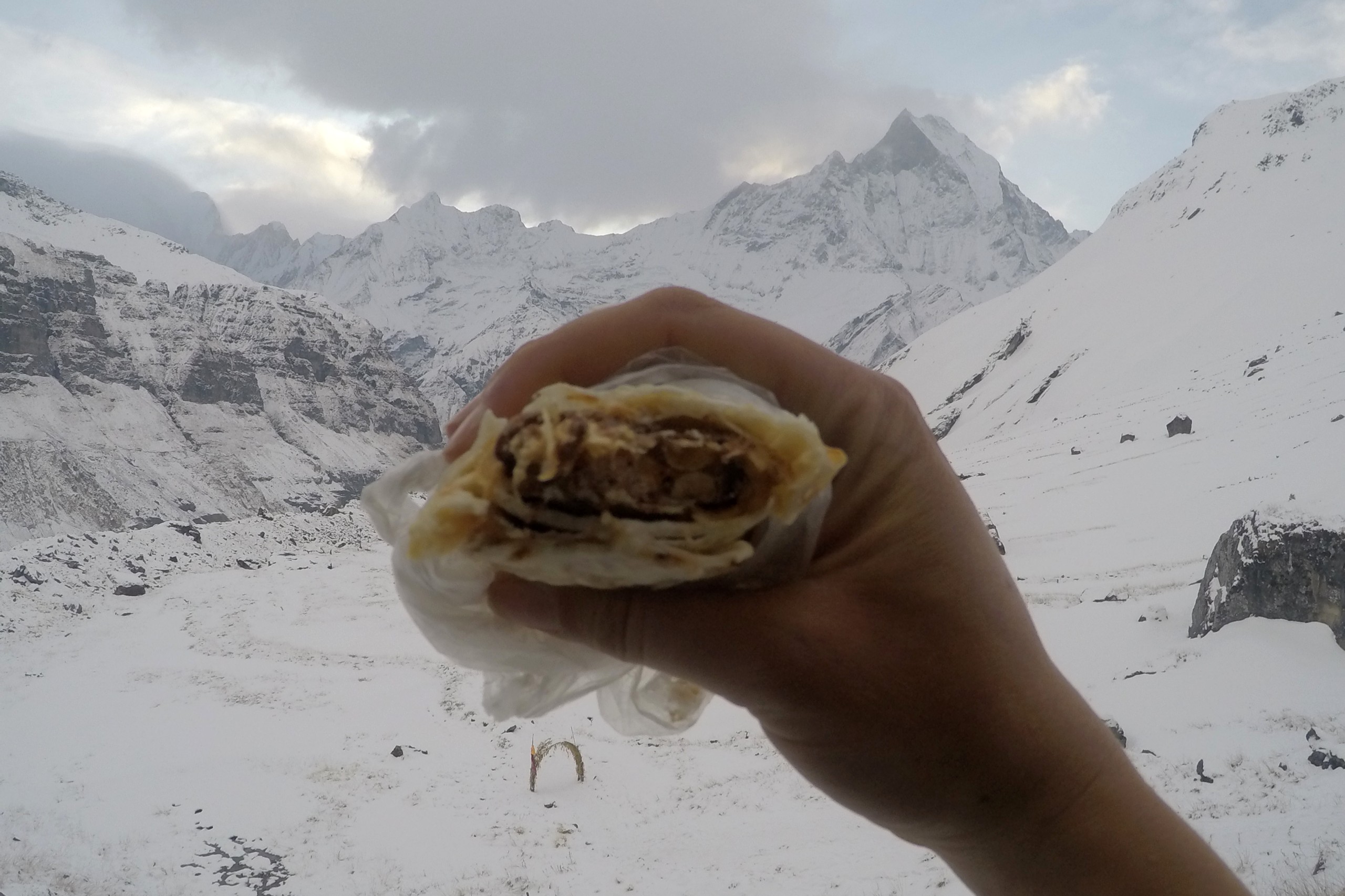
The scenery will be in my memory for a long time, but perhaps what I will remember most are the small moments shared with other trekkers. I’ll reminisce about the days spent hiking alongside strangers turned friends, swapping stories beneath the shadow of the Himalayas. I’ll smile back on the time I found an apple orchard along the trail and carried two kilograms of apples in my pack. I’ll laugh about the time we went to every shop in Manang in search of a spoon. I’ll tell stories about the time we accidentally trekked into Upper Mustang (a HUGE fine if caught) while looking for the village of Jhong. And of course, I’ll never look at a jar of peanut butter without thinking of the peaks where we stopped for an Elevation Creation (PB-snickers-wrap, patent pending).

DCIM100GOPROGOPR1699.

Enjoying an Elevation Creation at Annapurna Base Camp (~4200 m)

It’s the little things. Stop to dip your feet in the stream. You might end up going for a swim. Sit on a rock and watch the skyline. You might catch a glimpse of something beautiful.  Strike up a conversation with a stranger. You might find an unlikely friend.