A story from my time living on the farm in Chitwan.

The local temple for the community of Bhagauli
The air is cool, and the surrounding fields are concealed by thick fog. It’s a typical morning in the southern Terai Plains of Nepal. I clutch a tin mug of steaming hot masala chiya, still waking up. Anjana, my host mom, is running around making preparations to go to the temple. Today is the first of a 15-day rotation to give puja (worship) at the community temple. All women from the twenty households take turns performing temple duty (unless they are on their period in which case they aren’t allowed to enter the temple). At sunrise they give offerings and clean the temple, and at sunset they give a shorter puja.
As I lazily sip my tea, Anjana is busy. She cleanses herself using water heated on the stove then organizes her supplies: a copper plate with red & yellow paint, a gold flask holding water, and a small bowl of coconut pieces. All of these are offerings to the gods. Along the short walk to the temple, we collect more: red & purple flowers growing along the creek and young grass chutes from the field.
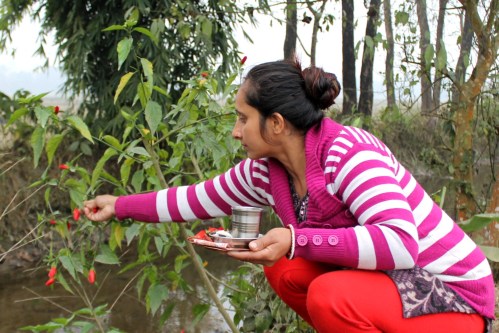
Anjana collecting red flowers for puja
Once we arrive at the temple, we take off our shoes and touch our foreheads to the foundation of the temple. Anjana unlocks the door and turns on a large speaker which broadcasts Nepali music. This is call to the neighborhood children who wander to the temple. I dance along with the music, twirling and weaving my hands back and forth in an attempt at traditional Nepali dance. The children watch with shy smiles.
Anjana begins to clean and arrange her supplies. She hands me a broom & mop, and I set to work cleaning the surrounding area. I sweep clockwise around the temple, making sure to always keep the building on my right side. I then move on to the large shelter area, moving around fountain, cow statue, fire pit, medicine plant, and spiral candle stand. It’s menial work, but I’m happy to have a role in morning puja.
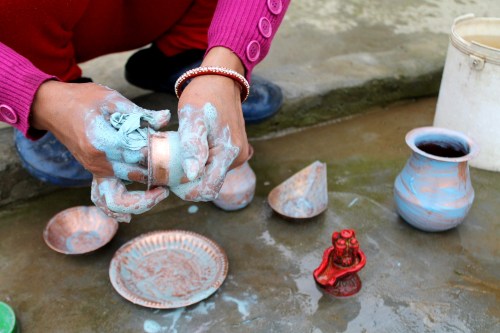
Cleaning the worship objects
After the cleaning is finished, I grab a stool and quietly sit behind Anjana in the temple. A statue of two gods smile down at me. I am told they are Shiva and Parvati, the parents of Ganesh, The Remover of Obstacles and God of New Beginnings. This temple pays tribute to this trio of gods. One village over, they may have different patron gods. Hinduism teaches that God is in everything and all the gods are actually different manifestations of one god. With this faith, there can be countless Hindu gods, as infinite as stars in the sky.
Anjana sings quietly as she cleans the statues and lays offerings at their feet. She lights an oil lamp and incense before backing out of the temple, never turning her back on the gods. Above the door she pours water from her gold flask to cleanse the surface. Then she places a dab of yellow & red paint on the frame along flowers, grass, and coconut. She repeats this process many times; over the fountain, at the cow statue, on the bells, beneath the medicine plant, in the fire pit, and finally she places her oil lamp in the spiral stand. She says a mantra and sends her prayers up to the sun.
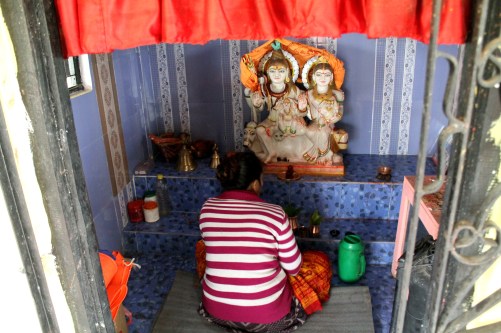
Giving offerings to Shiva & Parvati inside the temple
Anjana turns to me and gives me the final blessing, along with any children who have wandered to the temple. I receive tikka on my forehead, a flower in my hair, and a piece of coconut. Namaste, she says to me. The god in me honors the god in you. Dhanyabad, I say back. Thank you.
Religions can be beautiful. Hinduism is no exception. Sometimes we are so focused on our own paths that we miss the beauty in the paths running parallel to ours. All the paths are leading to the same place. It’s okay to take a detour.
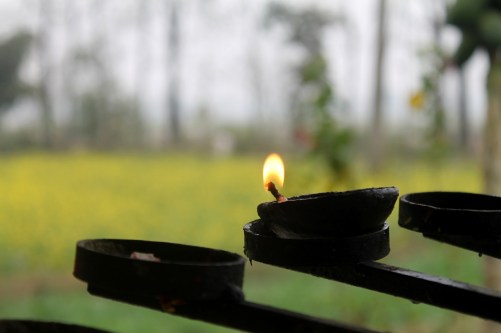
An oil lamp burning outside the temple, an offering to the sun
 Bridging the Gap