Balloons Over Laos

IMG_2143.JPG

I sat on a bench outside my hostel at 5:00am. The town of Vang Vieng around me was completely dark and silent. I was patiently waiting for a tuk tuk to take me to the launch field where in a couple hours I would hop in a giant basket and take my first ever hot air balloon ride.

Before this trip, I didn’t have any particular interest in hot air balloons. I’d never seen them advertised in the Midwest and didn’t know anyone who had ever been on one. The hot air balloon rides I had heard of were in the Southwest and ridiculously expensive, with the cheapest ride costing over $200. However, when I was told about the $90 hot air balloon flights in Laos, it was on my list. In fact, it was the only thing on my list for Laos.

As luck would have it, our route passed through the town of Vang Vieng, a backpacker hangout in Laos roughly equivalent to Thailand’s hippy paradise of Pai. The town was known for its striking limestone karst hills, extensive cave systems, and crystal clear lagoons. Vang Vieng also happened to be the place rumored to have Asia’s cheapest hot air balloon rides. This was proven to be true when we arrived at our hostel which advertised the $90 hot air balloon experience. They offered a shuttle service from the hostel to the launch field and had flights everyday in the morning and evening. I didn’t need to know anything more. I was already sold.
IMG_2331.JPG

I waited until our last morning in Vang Vieng to go on my hot air balloon ride. I figured morning would be both the clearest and the coolest. Plus, what better way to end my four days in Vang Vieng than by floating over the town I’d grown to love.

However, by 6:30am I was beginning to wonder if I was actually going on a hot air balloon ride. It was normal for transportation in Laos to be delayed, but an hour and a half was pretty late. I wasn’t able to contact the company on my phone, so I reluctantly knocked on the door to the staff sleeping quarters. The owner of the hostel emerged, still groggy. I showed him my ticket with a 5:00am pick up time for the hot air balloon ride. He perked up, dialed the number of the company, and handed me his phone. When a man on the other end picked up, I asked, “Are you coming to Jenin Hostel? My ticket says pick up time was 5:00am.” They assured me they were on their way.

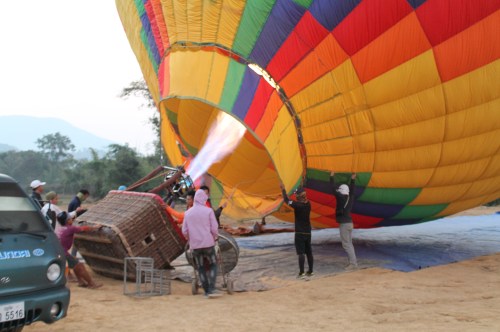
When I hung up the phone, the owner was awake enough to piece together what was going on. He didn’t know much English, but I gathered that I was supposed to go out back to the large parking lot behind the hostel. I walked out back and, sure enough, there was a hot air balloon being inflated just a few hundred feet from where I had been waiting for my ride. I didn’t need a ride, I just needed to walk into the backyard! I gathered with the other tourists to watch as the burners inflated the giant nylon balloon that would eventually carry us up into the sky.

Or so I thought.
IMG_2139.JPG

As I was snapping pictures, a young Lao guy approached me and asked to see my ticket. I showed him and watched his eyebrows raise. He said something in Lao to another man standing nearby. The two conversed and then motioned me to follow a third guy. Confused, but completely trusting, I followed the guy out of the parking lot, back through my hostel, and into the back of a pick-up truck. Without saying a word, we sped off to the outskirts of the town where I was dropped off at another launch where another hot air balloon was just finishing the inflation process. They checked my ticket and gave me a nod of approval. I breathed a sigh of relief. Never a dull moment.

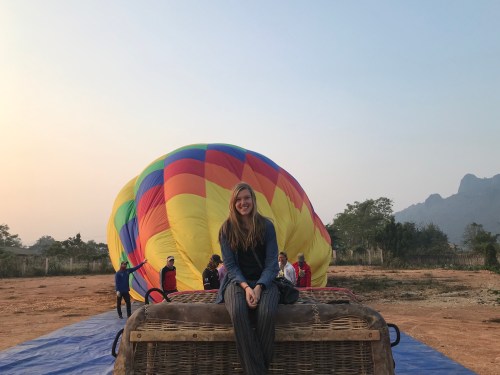
Within minutes after I arrived, I was climbing up into the basket with four other tourists plus a pilot and copilot. The pilot spoke English quite well and instructed us not to touch the burner or any of the lines. When the hot air balloon landed, we would crouch down to prepare for impact. That was the safety briefing. No waivers, no contingency plan, no questions… No surprise, really!
IMG_2394.JPG

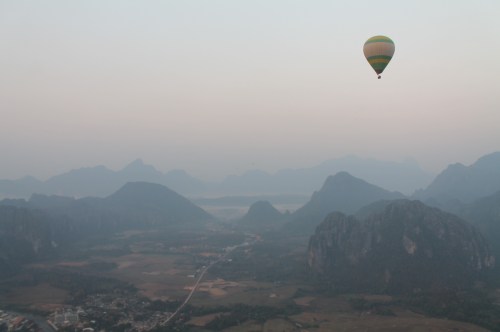
I’m not afraid of heights, nor had I been apprehensive about the hot air balloon ride, but as the men around me released the basket and we began to lift off the ground, I felt a small knot in my stomach. As we cleared the trees at the edge of the launch, my stomach eased and I felt a smile spread across my face. I was flying – no – I was floating above the ground. It was like my favorite part of takeoff on an airplane, but much smoother and with greater clarity.

What they didn’t tell us was that contrary to how they look as they serenely float through the sky, hot air balloons are not quiet. In order to keep the balloon afloat, the pilot needs to occasionally run the burner. It went from near perfect silence to a loud release of hot air being blasted into the balloon that produced a wave of heat that washed over our heads. This startled me the first couple times, but as we drifted higher into the sky, I forgot about the noise.

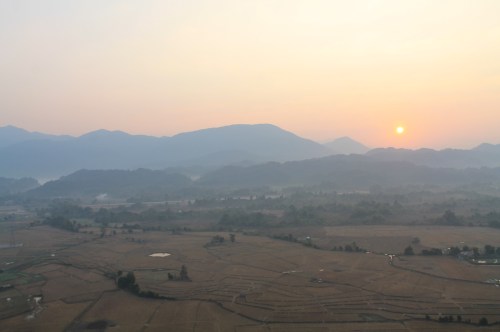
It was beautiful. Every direction I looked had me transfixed. Gone was the noise of the traffic, the mangy stray dogs, the trash in the street, the hardships of daily life. Floating 2,000 ft above, everything looked perfect.
IMG_2150.JPG

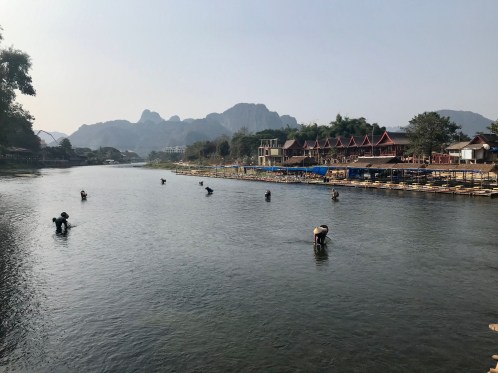
I saw all the same things I’d seen over the past four days, but they were different. There was Phapoak Mountain that we had scrambled up on our first day in Vang Vieng. It had taken us half an hour of hard climbing to get to the top, but the mountain looked like a molehill from the sky. Although I couldn’t see them, I knew that hidden in the mountain and surrounding hills were dozens of deep caves housing statues of Buddha and other spiritual relics. I could see the Nam Song River that we had spent hours tubing down the day before. It appeared gentle, but I knew there were plenty of rocks beneath its calm surface. And there was the construction China-Laos Railway, a great advancement in Laos transportation that will simultaneously strengthens China’s grip on the small landlocked country. A gift from China, to China.

All too soon, our pilot told us we were beginning our descent. We had been floating half an hour, but it felt like minutes. As our balloon came down, things came into focus. It was 7:30am and the town was waking up. Shop owners rolled up the front gates of their stores and food vendors wheeled their carts down the street. As they physically prepared for another day of work, I mentally prepared to leave; not only to leave Vang Vieng, but leave Laos, and eventually leave Asia.

All good things come to an end. But if that’s true, all good things must come to a start too. Although my month of travel in Thailand and Laos is coming to an end, on the horizon is a new adventure. This May I will pack up my six years in La Crosse and move to the East Coast to begin a series of physical therapy clinicals. Like my travels of the past month, I will undoubtedly make mistakes, learn, and grow. And like my travels of the past 25 years, I will always find time to get out and explore!
IMG_4096.JPG

Do You Remember?

IMG_2429.jpg

Do you remember when we used to talk to one another?
When conversations took place on the sidewalk rather than on an app,
And we looked into each other’s eyes rather than into a screen.

Do you remember when we wandered around with nothing but a paper map?
When we got directions from a shop owner rather than a GPS,
And asked our questions to other people rather than Google.

Remember when we captured moments through our eyes rather than a lens?
When there was no need to share everything we did with the world,
When our own approval was enough.

Remember when we used to get letters instead of likes?
Or made memories instead of posts,
Friends instead of followers.

Do you remember these things?

Because I’m starting to forget.

Slow Boat to Laos

Two days traveling down the Mekong River into a country that appears sunny and serene, but has a dark and devastating past.

IMG-2305.jpg

It had always been the plan to cross the border of Northern Thailand into Laos. However, Laos had always seemed so distant that I hadn’t done any research on how to cross the border or even what we would find once we crossed it. Like most of the trip, the plan was to figure it out along the way.

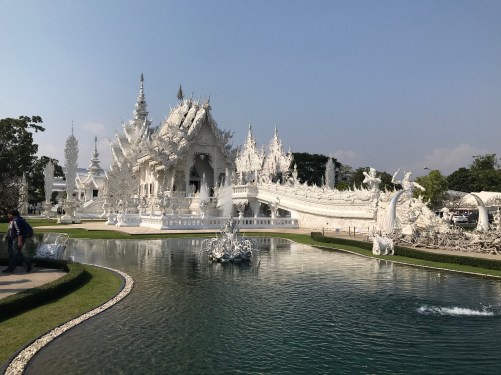
After two weeks of traveling North through Thailand, we found ourselves in Chiang Rai, the gateway city for backpackers traveling to Laos and Burma, the two countries that form the Golden Triangle with Thailand. Chiang Rai was a relatively lackluster city after all the excitement of Pai. Though there were plenty of gorgeous wats & architecture with colorful names (White Temple, Blue Temple, Black House), the natural attractions and parks were outside the city.

We decided to spend just one day in Chiang Rai to explore the city, do laundry, and figure out how to get to Laos. Laundry and finding information on crossing the border was surprisingly simple – our hostel offered both services! After chatting with the owner of the hostel, we discovered there were three ways to cross into Laos: land, water, or air. Since we were on a budget, flying was ruled out. That left bus or boat as our transportation options. Over land would take 14 hours and a sleepless night on a sleeper bus. The slow boat, on the other hand, was a two day journey traveling on the Mekong River for seven hours each day and stopping to overnight in the riverside village of Pak Beng. Though bus was faster, the slow boat into Laos seemed the obvious choice. We booked our transport across the border into Laos and the boat ride for 1,650 Bhat ($55). Trip planning here is almost too easy!

IMG-2268.jpg

After we’d booked our ticket and done laundry, all that was left to do was explore the city. Following the advice of other travelers, we hopped a local bus to see the White Temple, a stunning piece of modern art mixed with traditional Thai-Buddhist architecture. We wandered around the temple, grabbed some lunch, and waited patiently for a tuk tuk ride back to city center. In the city we wandered in and out of shops and investigated the night market, which was good, but not as good as the street food in Pai.

A full day in Chiang Rai was enough.

The next morning our bags were packed and we were standing by the door of our hostel at 6:00am. The owner of the hostel had very kindly backed us paper bag lunch the night before complete with banana pancakes, bread, bananas, and a hard boiled egg. I bought a couple sweet roti from a local food stand and a jar of fresh ground peanut butter from our hostel. Plenty of food for the day!

Forty minutes later a small white car pulled up and a small Thai woman with short hair hopped out and quickly loaded our bags in the trunk and ushered us into the car. She spoke no English, and we spoke no Thai. Like so many times before, we trusted that she would take us to the right place. We assumed that she was taking us to a bus station that would transfer us to the border of Laos. However, as we left the city limits of Chiang Rai, we realized that we were going the whole two hour journey by private car. You really never know what you’re going to get here.

We arrived at the Thai Border Control where we were stamped out of Thailand and quickly escorted to a bus waiting to take us to Laos Immigration. Before we left, our private driver took a quick photo of each of us passing through border control, likely looking quite dazed & confused. She waved goodbye and headed back to Thailand.

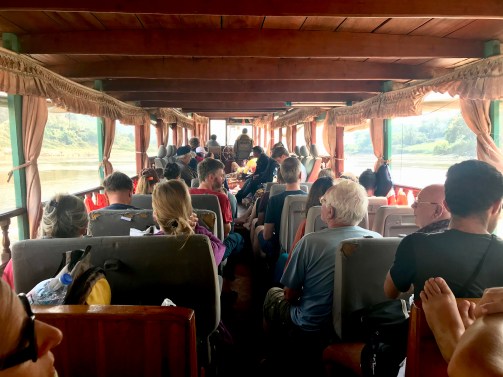
Everything else ran quite smoothly: we rode a bus over the Mekong River into Laos, paid our $35 visa fee, and were guided to a series of tuk tuks that eventually took us to the boat landing in Huay Xai where we were given our tickets for the two day journey by slow boat down the Mekong River. We boarded our boat just before 11:00am and got comfortable. Or tried to get comfortable. The seats were wooden benches placed so close together that our knees knocked the bench in front. On top of that, we discovered that the benches weren’t bolted down so every time we moved, our seat moved too. This was going to be a long ride.

IMG-2279.jpg

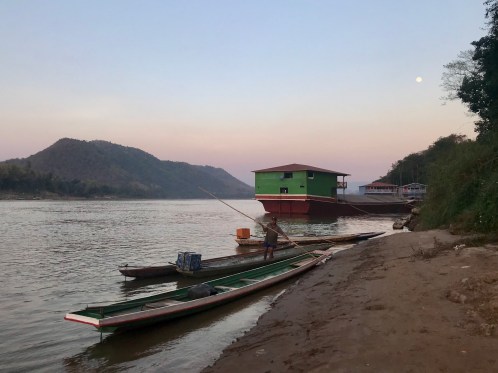
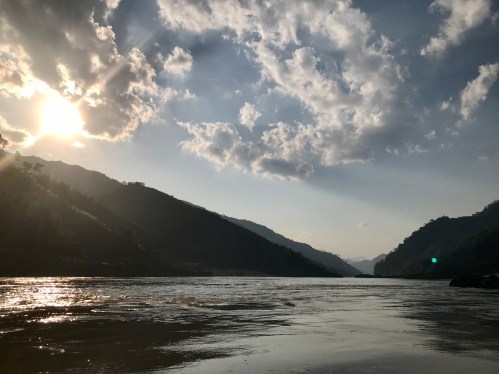
However, as our boat pulled away from the port and started traveling down the river deeper into Laos, we were distracted from the discomfort by the scenery. Soon the flat sandy shores began to rise and foothills appeared upon the horizon. Jagged tan rocks jutted out from the water, posing as treacherous obstacles if our boat ran off course. Local villagers gathered on the shores with nets and in fishing boats. Children bathed and played in the river while their mothers washed clothes. I was also kept distracted by a couple lively gals from the UK who were traveling the world for a year. They were full of great stories from previous adventures in Canada, Mexico, and Central/South America.

A few hours into the trip we passed by a man waving a yellow flag and calling out to our boat driver in Lao. We pulled over to the shore to wait for the unknown dangers ahead to clear. After multiple translations of the story in something like a game of international telephone, we found out that a power line was down and strung low across the river. A couple local long boats were able to hoist it up using a few long sticks and our boat was able to safely skim under the line and continue the journey to Pak Beng, our resting spot for the night.

IMG-2284.jpg

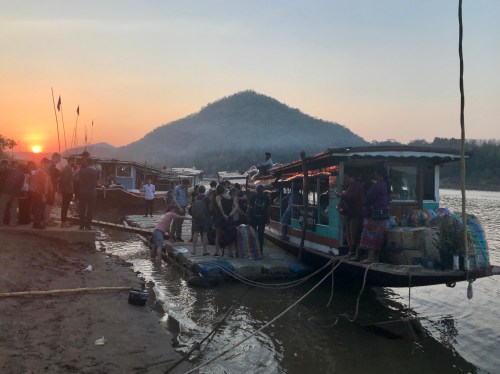
We arrived at the village just before sunset and were immediately bombarded with young men trying to market various local hotels, restaurants, and bars. We had already booked a hotel at the boat dock in Huay Xai so we simply found our hotel’s tuk tuk and went a few minutes up the road to a simple hotel with a nice view of the Mekong River.

We dropped our bags off in our room and went to the dining area to find a real meal (the bread, bananas, and pancakes were good, but not substantial). We asked the hotel owner what he recommended for our first meal in Laos and he told us we needed to get the koy with sticky rice. I asked if he could prepare it with tofu or vegetables instead of buffalo/chicken/pork. He looked at me like I was crazy and said “no” (later I would find out that koy is also known as laap which translates into “meat salad”). I swallowed my vegetarian pride and told him chicken would be fine. In truth, I’m not a strict vegetarian, especially when traveling abroad.

We sat on the patio by an Italian gentleman and a group of French folks that were also traveling on our boat. We grabbed some BeerLao and chatted with our fellow travelers while we waited for our meals to come. Soon they placed in front of me a heaping plate of minced chicken with garlic, mint, cilantro, lemongrass, and a host of other spices. Along side was a little basket of sticky rice. We were instructed that to enjoy this classic Laos dish the traditional way, we were to pull apart the sticky rice with our hands and use the rice to pick up the meat. No utensils needed. Not only was the koy & sticky rice delicious, but it was fun to eat with my hands! Not something I could do in a restaurant back home.

IMG-2298.jpg

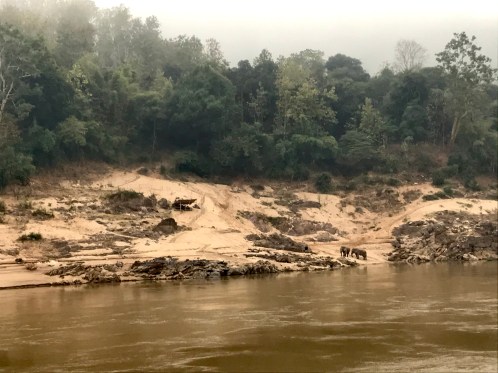
The next morning I woke before 7:00am to see the elephants come down from the Mekong Elephant Park across the river. I filled my thermos with tea and made my way through the tall grass and out onto the rocky banks of the Mekong River. As I stood and sipped my tea, two elephants were led down to the water by two young mahouts. The elephant trainers lounged waiting for the elephants to put on a show for the tourists watching on the opposite bank. However the elephants weren’t interested in the river or the tourists. Almost in defiance, they turned their large rear ends toward the river and waited to go back into the forest where there was plenty of food and water. One elephant expressed his opinion by taking the opportunity to relieve himself in the river. The scene was not anything out of National Geographic, but I found it pretty hilarious!

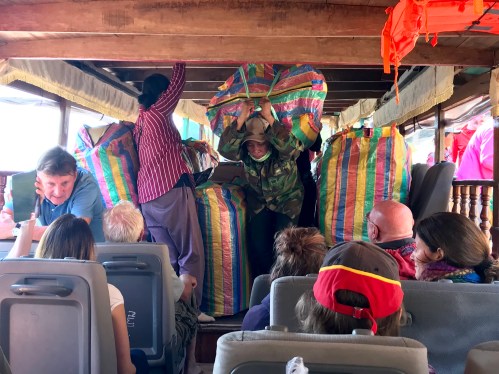
By 9:30am we were cruising down the river again. Today we had changed to a different boat and it was a major upgrade. The seats were recycled cushioned benches from old vans and much more comfortable. I had room to stretch my legs and even space to place my backpack under the seat in front of me. It felt like a first class cruise compared to yesterday! That is, until an hour into our ride when we stopped at a village dock that was packed with over 50 large pieces of cargo and passengers. I thought, there’s no way they can fit everything on this already full boat. But one by one, the people and packages were loaded onto the boat, some on the roof, some in the front, some in the engine room. The whole process took about half an hour, and by the end we were riding low in the water. But we were still afloat, so off we went!

IMG-2302.jpg

The second day passed quickly. I spent most of the time looking out the window and the scenery passing by, sometimes listening to music, but mostly enjoying the sounds of the boat, river, and people around me. I read a little, napped a little, and before I knew it, we were pulling up to the city of Luang Prabang, our final destination by boat. The sun was setting as they unloaded the boat and we made our way up the hill to catch a tuk tuk into city center and our hostel.

We had spent 14 hours traveling 185 km of the Mekong River into Laos. We’d seen a lot during our two days on the boat, but still knew very little about the country. We hadn’t yet swam in the unbelievably blue waterfalls and lagoons or scrambled up the limestone karst hills and into caves. We also knew nothing of the vast areas of land that lay untouched since the 1960’s when the U.S. dropped two million tons of bombs on the country during the Vietnam War – 30% of which never detonated.

But we would learn. The good, the bad, and the ugly. When you travel, you always learn.

IMG-2306.jpg

Slice of Pai

Carefully making my way over canyon spines, climbing up the rock faces of waterfalls, and learning to ride motorbikes… The kinds of things you don’t tell your parents until later.

IMG_2114.jpg

After four days in Bangkok, I was ready to leave the city and see the country. Don’t get me wrong, Bangkok was a fun city with it’s bustling street markets, rooftop restaurants, and wats (temples) on every corner. With simple, accessible public transport, I had no problems traveling solo throughout the city. I grew confident in my last couple days and stayed out past dark, feeling completely safe as I made my way back to my  hostel by metro. There was still plenty of the city I could explore, but I would be back in a few weeks. It was time for a change of scenery.

I hopped a train to the airport just outside the city where I met my travel buddy, Bastian. We had met backpacking the Annapurna Circuit together in Nepal and were ready to take on Northern Thailand and Laos. However, this was a different style of travel. Rather than putting in dozens kilometers on foot over a backpacking trail, we would be putting in hundreds of kilometers via plane, bus, and boat getting to various cities on a popular backpacker route (known as the Banana Pancake Route). We would spend just a few days in each city, sampling the culture, food, and scenery before moving on to the next. We would head North, planning as we went, getting advice from other travelers along the way. A new style of travel for me, one that promises spontaneity and adventure!

IMG_2114.JPG

On New Year’s Eve we flew up to Chiang Mai, just in time for the floating lantern celebration. Hundreds of paper lanterns were launched into the sky throughout the evening, with a huge flood of lanterns released at midnight. Some floated dreamily into the night, others quite literally crashed and burned. A bit of a fire hazard? Probably. A unique way to bring in 2020? Absolutely!

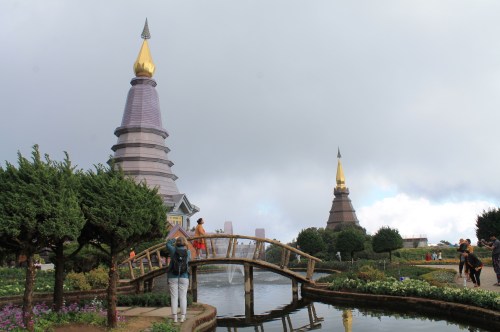
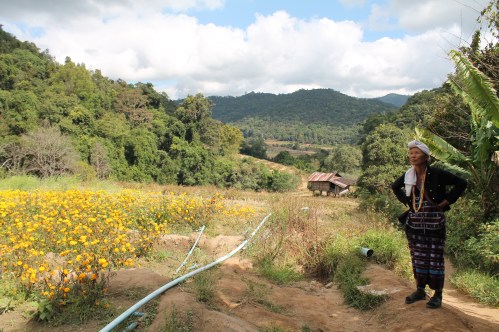
Our next couple days were spent exploring the mountains surrounding the city. There are several ranges in Northern Thailand, but in general they are collectively referred to as the Thai Highlands. They are relatively low elevation, with the tallest, Doi Inthanon, only rising 2,565 m (8,415 ft) above sea level. The Thai Highlands are actually considered the foothills to the Himalayas, growing higher in Burma before stretching into India and eventually reaching Nepal. Someday I’ll follow them back to Nepal. Maybe in a couple years. But it’s impossible to plan that far in advance. You can try, but life is unpredictable and takes you to some unexpected places. Like Thailand and Laos!

IMG_2097.JPG

Chiang Mai, to my surprise, was a big city. The fourth biggest city in Thailand with over 174,000 residents and LOADS of tourists. So we continued North in search of something less busy and came across the town of Pai. This was one of the few cities that we had planned to visit on the trip. Other travelers we met in Nepal had raved about the beauty and solitude of this little backpacker village. It was off the main route North, but we were assured it was well worth the detour. And it was.

We arrived to Pai in the afternoon after a 3 hour drive through winding mountain roads. We dropped our packs at our hostel and walked into town. Exploring the actual village of Pai doesn’t take long; it has just one main walking road and a few side streets lined with shops and restaurants. Nothing too impressive. Until the sun set.

IMG_2320.jpg

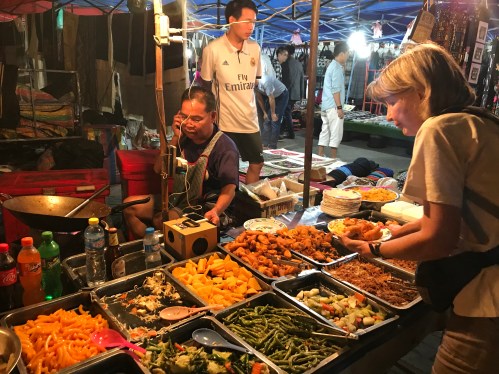
Starting around 7:00pm the main road was closed off to vehicles and street food stands began to pop up. There was typical Thai food I’d encountered in Bangkok & Chiang Mai: pad thai prepared in a large wok, fried roti with banana, fresh fruit smoothies, and all sorts of barbecued fish & meats. But there was also foods from all over the world: Indian curries wrapped in naan bread, Mediterranean hummus & falafel in pita, huge slices of avocado on French baguettes, and a wide assortment of teas served in tall bamboo shoots (a personal favorite). We spent hours wandering through the streets of the night market, sampling all sorts of foods and observing all sorts of people (Pai attracts some colorful characters). This would become a nightly routine during our three days in Pai.

For our first full day in Pai we had one goal: learn to ride motorbike. I hadn’t intended to rent a motorbike during my travels. I didn’t know how to drive motorbike, and I didn’t have a motorbike license, let alone an international driver’s license. Oh yeah, and motorbikes are dangerous. Especially having to drive them on the left side of the road. Traveling by motorbike seemed out of the question.

However, the more travelers I talked to, the more told me that it was an essential experience to ride a motorbike when traveling Southeast Asia. It’s cheap (usually $6 for 24 hours) and allows you to see more of the country. They told me it didn’t matter that I had never operated a motor bike. Many of them had learned to drive in Asia themselves and told me as long as I wore a helmet & was a smart driver, I would be fine. As far as the license goes, most people don’t have licenses. If you get pulled over, you pay the 400 bhat fee (about $15 USD) and continue on your way. If you get pulled over again, just pull out your ticket to prove you paid the fee already. Easy.

Yet, I wasn’t fully convinced until I met another female solo traveler who had learned how to ride motorbike in Pai last month. She told me it was the perfect place to learn; a small town with wide paved roads and little traffic. She gave me the name of a rental shop where the owner will give you a lesson before cutting you loose on the roads.

So that settled it. I was going to learn to ride motor bike. I would tell my parents later.

img_7757.jpg

The motorbike rental shop, Vespai, was located on a quiet side street lined with a few hotels. When we arrived at 11:00am there were six people waiting for lessons and motorbikes. We were going to wait awhile, but when traveling in Asia, you learn to be patient. While watching the new riders troddle down the street, we struck up a conversation with a young gal named Emily from Australia who was vacationing in Thailand with her family. They had rejected her idea to go to Pai, so she decided to venture North solo while they stayed in Chiang Mai. I liked her already.

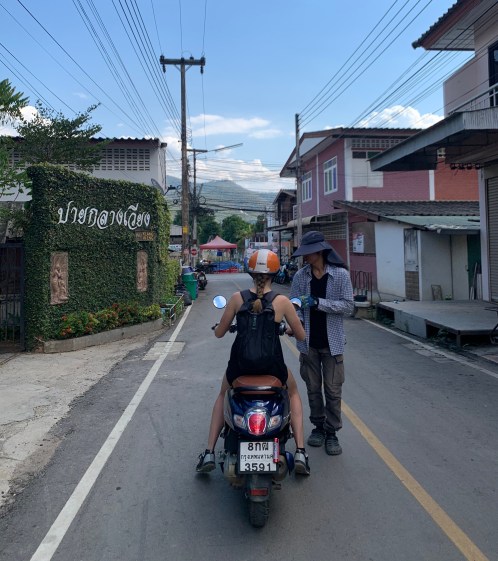
After an hour, it was just the three of us standing at the shop, and fortunately, three motorbikes left. By this time, I had watched quite a few lessons and was feeling good about getting on the bike. I knew how to work the ignition, brakes, turn signals, accelerator, and perform an emergency start. What else was there to know? After reacquainting me with the parts of the bike, I finally got on. We spent about 30 minutes learning to accelerate “slowly, slowly”, brake “slowly, slowly”, and turn the bike around “slowly, slowly”. Finally I was allowed to take the bike for a spin around the block. Amazingly, I made it all the way around. Going “slowly, slowly”, of course.

Soon Emily joined me in my circuits around the block, and eventually Bastian for just a couple laps (our instructor said he didn’t need as much practice because he was German and a man, so he catches quickly. Ugh.). The three of us pulled back up to the front of the shop for some final words of advice from our motorbike sensei: “Do not get overconfident. That is when accidents happen. Good luck.” And with that, we were cut loose to explore the streets of Pai and beyond.

img_8057.jpg

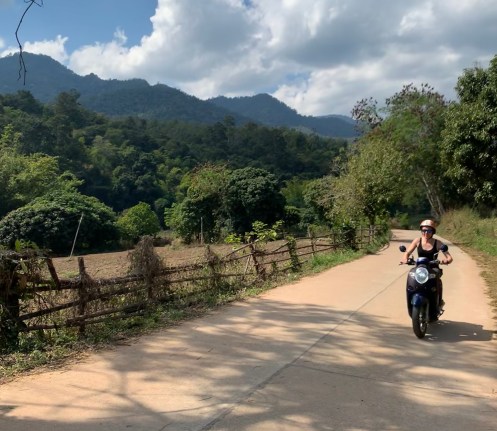
The three of us headed out on the main road, adrenaline pumping, riding toward some of the popular attractions just outside town: Pai Land Split, Pam Bok Waterfall, bamboo bridge, and Pai Canyon. We stopped along the way for lunch and found a beautiful vista overlooking the highlands. I could see roads weaving through the valley and felt a wave of excitement knowing that I was free to explore those roads with my motorbike. Ultimate freedom.

We turned off the main road and bumped along a smaller road leading towards the Land Split, waterfall, and bamboo bridge. We stopped along the way at a little pond with a few swings along the shore before finishing the short ride to the Land Split. This turned out to be a small canyon-like feature that was caused by several small earthquakes that had occurred over the past 12 years. We walked through the split, wondering out loud when the land would split again. Being located along the same fault line as the Himalayas, it’s only a matter of time.

IMG_2041.jpg

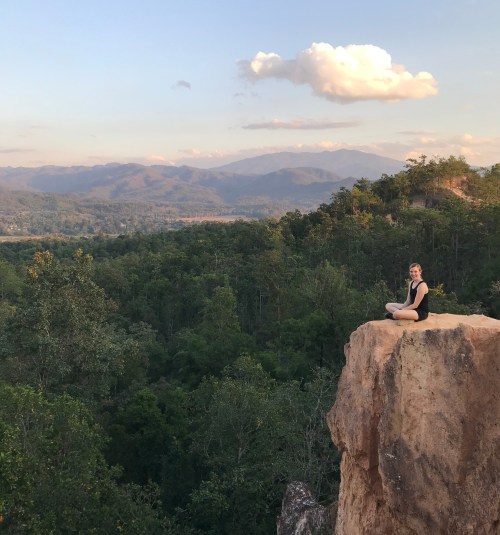
We had intended to ride on to the waterfall and bamboo bridge, but the sun was sinking low in the sky and we wanted to catch sunset at Pai Canyon. We took the little road back to the main paved road where we rode another 5 km to the canyon. We parked our bikes among dozens of others and made the short walk up to the canyon. I had seen pictures of the canyon, but was amazed by its size. The spine of the canyon divided and snaked it’s way back as far as I could see. Although there were dozens of other tourists at the canyon, we were all so spread out along the trail that it didn’t feel crowded. We walked back along the spine until we found the perfect sunset spot. As the sun sank behind the hills, I soaked in the colors of this foreign landscape. What a life.

img_2099.jpg

The next day we met up with Emily again to explore the places we didn’t have time to see the day before. We had the bikes until 2:30pm, so we got an early start to fit in Pam Bok Waterfall and the bamboo bridge. We turned down the same road we’d been on to the Land Split the day before. We didn’t know a thing about the waterfall or the bamboo bridge, but we’d quickly realized that when traveling by motorbike it was less about the destination and more about the ride. And the ride was gorgeous. It was mid-morning and the sun was giving a gentle warmth rather than the afternoon tropical heat. We passed houses on stilts and fields where buffalo grazed.

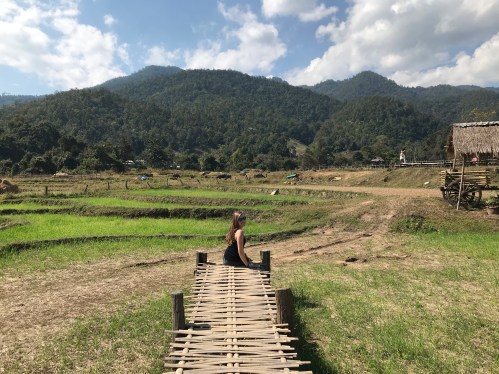
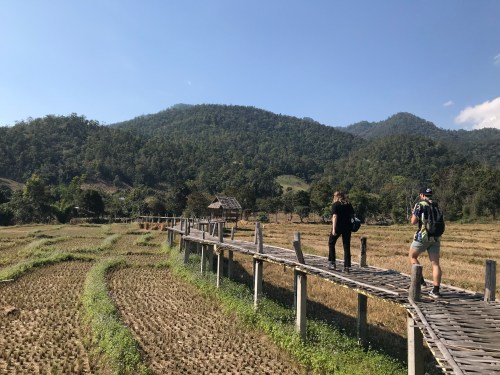
After about 30 minutes we reached the bamboo bridge and paid the small entrance fee. Similar to Pai Canyon, we had no idea what to expect. Similar to Pai Canyon, it was much longer than we realized. We walked along the creaky bridge through the rice fields, dry this time of year, and past farmers working the land. We eventually reached the end of the bridge where we found a wat (temple) in the forest. Classic Thailand.

IMG_2107.jpg

By the time we got off the bamboo bridge and returned to our motorbikes, it was beginning to get hot. We stopped for mango smoothies before continuing on to the waterfall. We parked our bikes in a gravel parking lot and climbed a short series of steps to the base of the falls. Here we found a dozen others perched on rocks, enjoying the falls and eating picnic lunches.

Only a few people were swimming, most finding the water too cold. I dipped in a toe and found it the perfect swimming temperature, no colder than the lakes of the Midwest that I grew up swimming in. I stripped down to a sports bra & underwear and jumped in! I swam beneath the falls then perched on a rock to the side of the falls. After watching a few guys climb the rocks and jump into the base of the falls, I gave it a try myself. The climb to the top of the rocks was a bit sharp & slippery, so once was enough.

e892962f-5b6a-47ea-a318-1075f82ed939.jpg

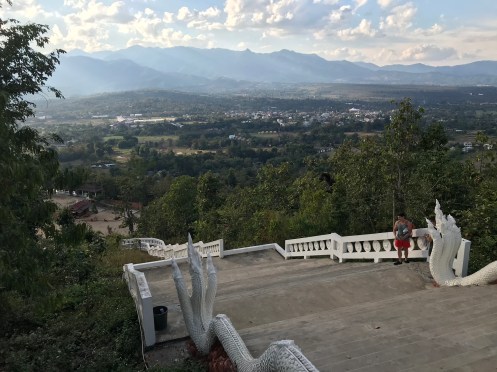
We dried off and mounted our motorbikes one last time to ride back into town. We arrived back at Vespai motorbike rental shop at 2:30pm exactly. We had officially made it 24 hours with a motorbike with no license, no experience, and thankfully, no incidents. Emily returned her bike, while Bastian & I kept our motorbikes for one more day to explore the Big White Buddha (Chedi Phra That Mae Yen) and do the first section of the hike to Mae Yen Waterfall (which we did barefoot).

Our time in Pai was over too quickly, as people warned us it would be. Although the scenery in Pai was amazing, what I liked most about the little backpacker haven was that it so perfectly represented why I love to travel. We met a perfect strangers who become an excellent travel partner, even if just for a day. We took risks hopping on a motorbike, but maintained our wits and saved our heads. We explored, we learned, and we moved on to the next place and the next adventure yet to unfold.

IMG_2260.jpg

P.S. I’m not planning to ride anymore motorbikes in Southeast Asia. You can breathe a sigh of relief Mom & Dad 😉