Two days traveling down the Mekong River into a country that appears sunny and serene, but has a dark and devastating past.
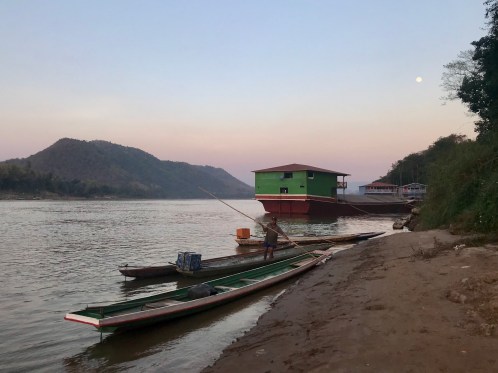
It had always been the plan to cross the border of Northern Thailand into Laos. However, Laos had always seemed so distant that I hadn’t done any research on how to cross the border or even what we would find once we crossed it. Like most of the trip, the plan was to figure it out along the way.
After two weeks of traveling North through Thailand, we found ourselves in Chiang Rai, the gateway city for backpackers traveling to Laos and Burma, the two countries that form the Golden Triangle with Thailand. Chiang Rai was a relatively lackluster city after all the excitement of Pai. Though there were plenty of gorgeous wats & architecture with colorful names (White Temple, Blue Temple, Black House), the natural attractions and parks were outside the city.
We decided to spend just one day in Chiang Rai to explore the city, do laundry, and figure out how to get to Laos. Laundry and finding information on crossing the border was surprisingly simple – our hostel offered both services! After chatting with the owner of the hostel, we discovered there were three ways to cross into Laos: land, water, or air. Since we were on a budget, flying was ruled out. That left bus or boat as our transportation options. Over land would take 14 hours and a sleepless night on a sleeper bus. The slow boat, on the other hand, was a two day journey traveling on the Mekong River for seven hours each day and stopping to overnight in the riverside village of Pak Beng. Though bus was faster, the slow boat into Laos seemed the obvious choice. We booked our transport across the border into Laos and the boat ride for 1,650 Bhat ($55). Trip planning here is almost too easy!
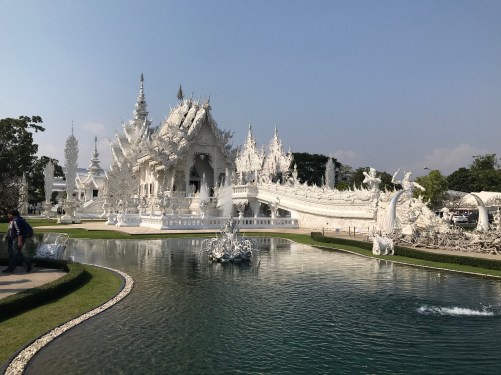
After we’d booked our ticket and done laundry, all that was left to do was explore the city. Following the advice of other travelers, we hopped a local bus to see the White Temple, a stunning piece of modern art mixed with traditional Thai-Buddhist architecture. We wandered around the temple, grabbed some lunch, and waited patiently for a tuk tuk ride back to city center. In the city we wandered in and out of shops and investigated the night market, which was good, but not as good as the street food in Pai.
A full day in Chiang Rai was enough.
The next morning our bags were packed and we were standing by the door of our hostel at 6:00am. The owner of the hostel had very kindly backed us paper bag lunch the night before complete with banana pancakes, bread, bananas, and a hard boiled egg. I bought a couple sweet roti from a local food stand and a jar of fresh ground peanut butter from our hostel. Plenty of food for the day!
Forty minutes later a small white car pulled up and a small Thai woman with short hair hopped out and quickly loaded our bags in the trunk and ushered us into the car. She spoke no English, and we spoke no Thai. Like so many times before, we trusted that she would take us to the right place. We assumed that she was taking us to a bus station that would transfer us to the border of Laos. However, as we left the city limits of Chiang Rai, we realized that we were going the whole two hour journey by private car. You really never know what you’re going to get here.
We arrived at the Thai Border Control where we were stamped out of Thailand and quickly escorted to a bus waiting to take us to Laos Immigration. Before we left, our private driver took a quick photo of each of us passing through border control, likely looking quite dazed & confused. She waved goodbye and headed back to Thailand.
Everything else ran quite smoothly: we rode a bus over the Mekong River into Laos, paid our $35 visa fee, and were guided to a series of tuk tuks that eventually took us to the boat landing in Huay Xai where we were given our tickets for the two day journey by slow boat down the Mekong River. We boarded our boat just before 11:00am and got comfortable. Or tried to get comfortable. The seats were wooden benches placed so close together that our knees knocked the bench in front. On top of that, we discovered that the benches weren’t bolted down so every time we moved, our seat moved too. This was going to be a long ride.
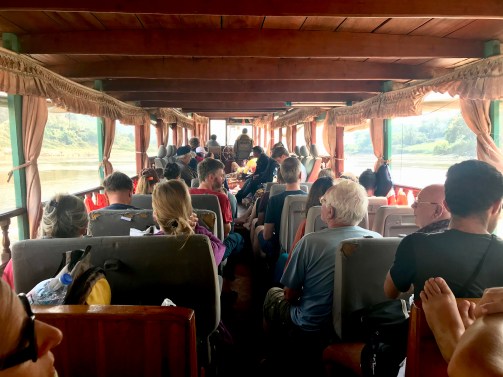
However, as our boat pulled away from the port and started traveling down the river deeper into Laos, we were distracted from the discomfort by the scenery. Soon the flat sandy shores began to rise and foothills appeared upon the horizon. Jagged tan rocks jutted out from the water, posing as treacherous obstacles if our boat ran off course. Local villagers gathered on the shores with nets and in fishing boats. Children bathed and played in the river while their mothers washed clothes. I was also kept distracted by a couple lively gals from the UK who were traveling the world for a year. They were full of great stories from previous adventures in Canada, Mexico, and Central/South America.
A few hours into the trip we passed by a man waving a yellow flag and calling out to our boat driver in Lao. We pulled over to the shore to wait for the unknown dangers ahead to clear. After multiple translations of the story in something like a game of international telephone, we found out that a power line was down and strung low across the river. A couple local long boats were able to hoist it up using a few long sticks and our boat was able to safely skim under the line and continue the journey to Pak Beng, our resting spot for the night.
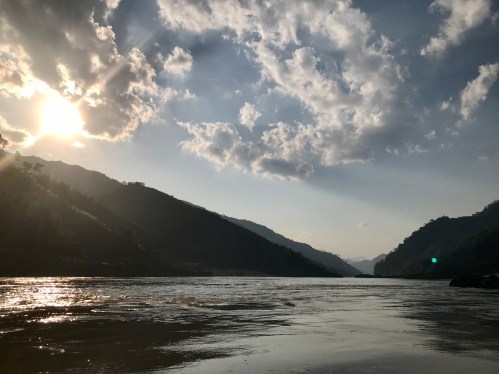
We arrived at the village just before sunset and were immediately bombarded with young men trying to market various local hotels, restaurants, and bars. We had already booked a hotel at the boat dock in Huay Xai so we simply found our hotel’s tuk tuk and went a few minutes up the road to a simple hotel with a nice view of the Mekong River.
We dropped our bags off in our room and went to the dining area to find a real meal (the bread, bananas, and pancakes were good, but not substantial). We asked the hotel owner what he recommended for our first meal in Laos and he told us we needed to get the koy with sticky rice. I asked if he could prepare it with tofu or vegetables instead of buffalo/chicken/pork. He looked at me like I was crazy and said “no” (later I would find out that koy is also known as laap which translates into “meat salad”). I swallowed my vegetarian pride and told him chicken would be fine. In truth, I’m not a strict vegetarian, especially when traveling abroad.
We sat on the patio by an Italian gentleman and a group of French folks that were also traveling on our boat. We grabbed some BeerLao and chatted with our fellow travelers while we waited for our meals to come. Soon they placed in front of me a heaping plate of minced chicken with garlic, mint, cilantro, lemongrass, and a host of other spices. Along side was a little basket of sticky rice. We were instructed that to enjoy this classic Laos dish the traditional way, we were to pull apart the sticky rice with our hands and use the rice to pick up the meat. No utensils needed. Not only was the koy & sticky rice delicious, but it was fun to eat with my hands! Not something I could do in a restaurant back home.
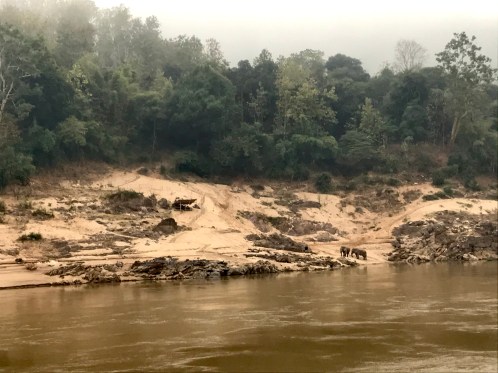
The next morning I woke before 7:00am to see the elephants come down from the Mekong Elephant Park across the river. I filled my thermos with tea and made my way through the tall grass and out onto the rocky banks of the Mekong River. As I stood and sipped my tea, two elephants were led down to the water by two young mahouts. The elephant trainers lounged waiting for the elephants to put on a show for the tourists watching on the opposite bank. However the elephants weren’t interested in the river or the tourists. Almost in defiance, they turned their large rear ends toward the river and waited to go back into the forest where there was plenty of food and water. One elephant expressed his opinion by taking the opportunity to relieve himself in the river. The scene was not anything out of National Geographic, but I found it pretty hilarious!
By 9:30am we were cruising down the river again. Today we had changed to a different boat and it was a major upgrade. The seats were recycled cushioned benches from old vans and much more comfortable. I had room to stretch my legs and even space to place my backpack under the seat in front of me. It felt like a first class cruise compared to yesterday! That is, until an hour into our ride when we stopped at a village dock that was packed with over 50 large pieces of cargo and passengers. I thought, there’s no way they can fit everything on this already full boat. But one by one, the people and packages were loaded onto the boat, some on the roof, some in the front, some in the engine room. The whole process took about half an hour, and by the end we were riding low in the water. But we were still afloat, so off we went!
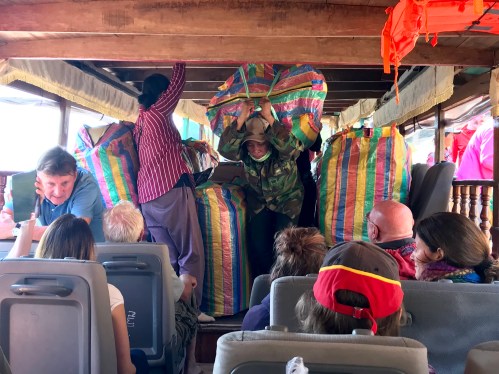
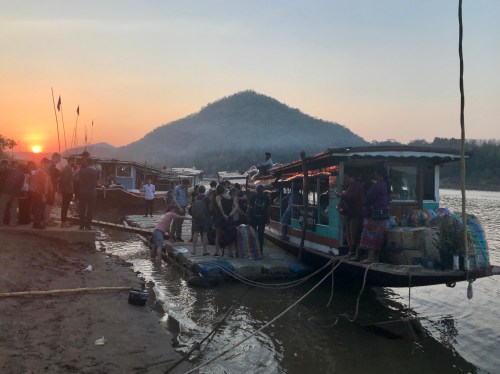
The second day passed quickly. I spent most of the time looking out the window and the scenery passing by, sometimes listening to music, but mostly enjoying the sounds of the boat, river, and people around me. I read a little, napped a little, and before I knew it, we were pulling up to the city of Luang Prabang, our final destination by boat. The sun was setting as they unloaded the boat and we made our way up the hill to catch a tuk tuk into city center and our hostel.
We had spent 14 hours traveling 185 km of the Mekong River into Laos. We’d seen a lot during our two days on the boat, but still knew very little about the country. We hadn’t yet swam in the unbelievably blue waterfalls and lagoons or scrambled up the limestone karst hills and into caves. We also knew nothing of the vast areas of land that lay untouched since the 1960’s when the U.S. dropped two million tons of bombs on the country during the Vietnam War – 30% of which never detonated.
But we would learn. The good, the bad, and the ugly. When you travel, you always learn.
 Bridging the Gap